
Identity-based networking: your directory decides who gets on
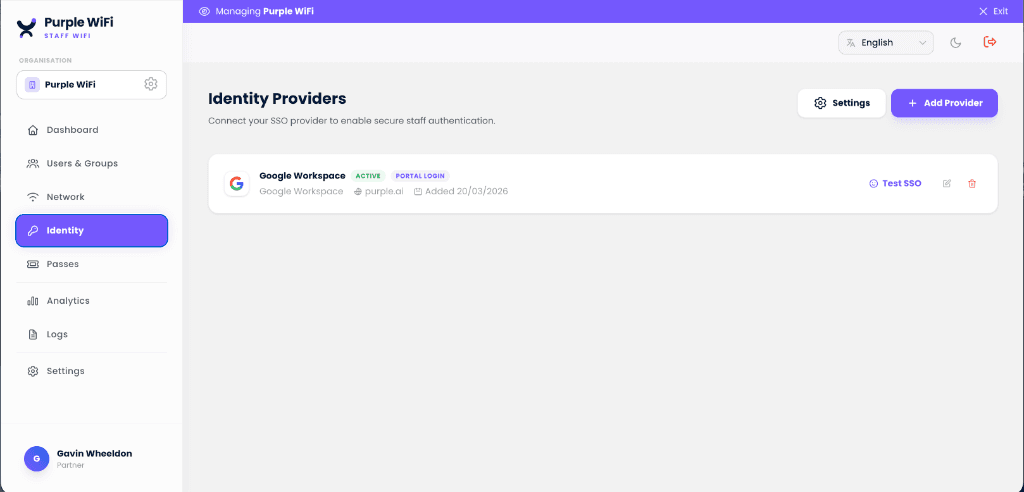
Entra ID, Okta or Google Workspace groups decide the VLAN, and disabling an account ends access at every site.
The problem
The network does not know who anyone is
On a shared secret, the network sees a password, not a person. Everything that follows from identity has to be done by hand.
No audit trail
A log that names a password
A log of a shared credential tells you nothing about who connected, so you cannot prove a leaver lost access.
One VLAN per SSID
VLANs set by SSID, not by role
Finance, contractors and staff land wherever their SSID points, so a team change means a new SSID or a manual ticket.
Offboarding
Leavers wait for someone to remember
Access ends when someone rotates the password or revokes a certificate, not when HR disables the account.
The solution
Your directory runs the network's access policy
Every connection is tied to a verified identity, not a shared secret. People authenticate through your directory, devices with their own certificate or key, and the network grants, scopes and withdraws access by that identity.
- SAML for sign-in, SCIM for syncSAML signs people in with the account they already have; SCIM keeps users and groups in step with Entra ID, Okta or Google Workspace.
- Groups map to VLANsEach directory group maps to a VLAN and role. At authentication, cloud RADIUS returns the attributes for that person's groups and your access points enforce them.
- Conditional Access and posture decide who joinsEntra ID Conditional Access is honoured. Compliance state and MDM enrolment from Microsoft Intune, Jamf Pro, JumpCloud, Iru (formerly Kandji), Hexnode and Addigy are checked at authentication, so a non-compliant device is refused.
- RADIUS CoA ends live sessionsDisable an account and Change of Authorisation ends the session already running, not only the next one.
Joiners, movers and leavers
Handled by the directory, not by tickets
Joiners get the right VLAN on day one
New users and their groups sync over SCIM. Their first authentication returns the VLAN for their groups, with no network ticket.
Movers land somewhere new without a ticket
Change a group in the directory and the next authentication returns the new VLAN and role.
Leavers lose access at every site
Disable the account and access ends everywhere, with live sessions killed by RADIUS CoA.
Prove it from the log
Every accept and reject is logged with identity, groups, device, VLAN and reason, and streamed to your SIEM.
Proof
Identity at the scale of the largest cloud RADIUS
- 500M
- logins a year
- 5,000
- JPMorgan branches on Purple staff WiFi
- 99.9%
- cloud RADIUS uptime SLA, in your contract
- ISO 27001 certified
- Cyber Essentials Plus
- Zero data breaches since 2012
Trusted by








Add-on: Purple Shield
Add Purple Shield to this network
Purple Shield is a separate product you add to your Access networks: a DNS policy per VLAN and by time of day. Page loads up to 500% faster, 20 to 40% less web traffic. Try it free for 30 days.
FAQ
Common questions
What is identity-based networking?
Every connection tied to a verified identity, not a shared secret. People authenticate through your directory, devices with their own certificate or key, and the network grants, scopes and withdraws access by that identity, at every site.
Which identity providers are supported?
Microsoft Entra ID, Okta and Google Workspace, over SAML and SCIM, with Entra ID Conditional Access honoured at authentication. Users and groups stay in sync, so the network follows the directory you already run.
Why both SAML and SCIM?
They do different jobs. SAML signs a person in with the account they already have, for example when installing a WiFi pass in the Purple Staff app. SCIM keeps users and group memberships in sync, so joiners, movers and leavers reach the network without anyone exporting a list.
How do directory groups become VLANs?
Each group maps to a VLAN and role in Purple. When a person authenticates, cloud RADIUS returns the attributes for their groups and your access points put them on that VLAN, on any of the eight access point brands we support.
What does RADIUS CoA do when someone leaves?
Change of Authorisation lets cloud RADIUS end a session that is already running. Disable the account in your directory and the person is taken off the network at every site straight away, not at their next sign-in or when a certificate expires.
Does it replace our NAC?
Yes. Compliance-gated join, Conditional Access, device posture and MDM enrolment state at authentication, from Microsoft Intune, Jamf Pro, JumpCloud, Iru (formerly Kandji), Hexnode and Addigy, with no ISE or ClearPass appliance to run.
What about devices with no user, like printers and cameras?
They cannot sign in to a directory, so each gets its own WiFi key (xPSK) with its own VLAN on the xPSK network. People stay on identity; things get a key each, revoked on its own.
Hand WiFi access to the directory you already trust
Bring your directory groups. We map each one to its VLAN. All in a 45-minute design session.
Book a demo
Tell us about your network
Led by a Purple network engineer. No slides.