
PCI Compliance WiFi: A Multi-Site Security Guide
Published
Most pci compliance wifi guides stop at “create a guest SSID.” That advice is too shallow to survive a real audit. PCI scope is not decided by the name on the network, it's decided by traffic paths, connectivity, and evidence that the cardholder data environment stays isolated.
If a wireless system can reach payment systems, or if you can't prove it can't, it belongs in the conversation. PCI guidance has treated Wi-Fi as a payment-security concern for years, and the core rule hasn't changed, scope follows data flow, not labels (PCI Wireless Guidelines). That means a guest SSID, a corporate SSID, and a “temporary” VLAN are all irrelevant if the underlying path still touches the CDE.
Table of Contents
- Why Guest WiFi Is Not Automatically Out of PCI Scope
- Proving Wireless Segmentation With Evidence the Assessor Will Accept
- Choosing the Right Authentication Model for PCI Wireless
- Identity Driven VLANs, Cloud RADIUS, and Strong Cryptography
- Logging, Monitoring, and Rogue Access Point Detection
- Remediation Playbook for the Most Common Wireless PCI Findings
- What Assessors Ask About Wireless
Why Guest WiFi Is Not Automatically Out of PCI Scope
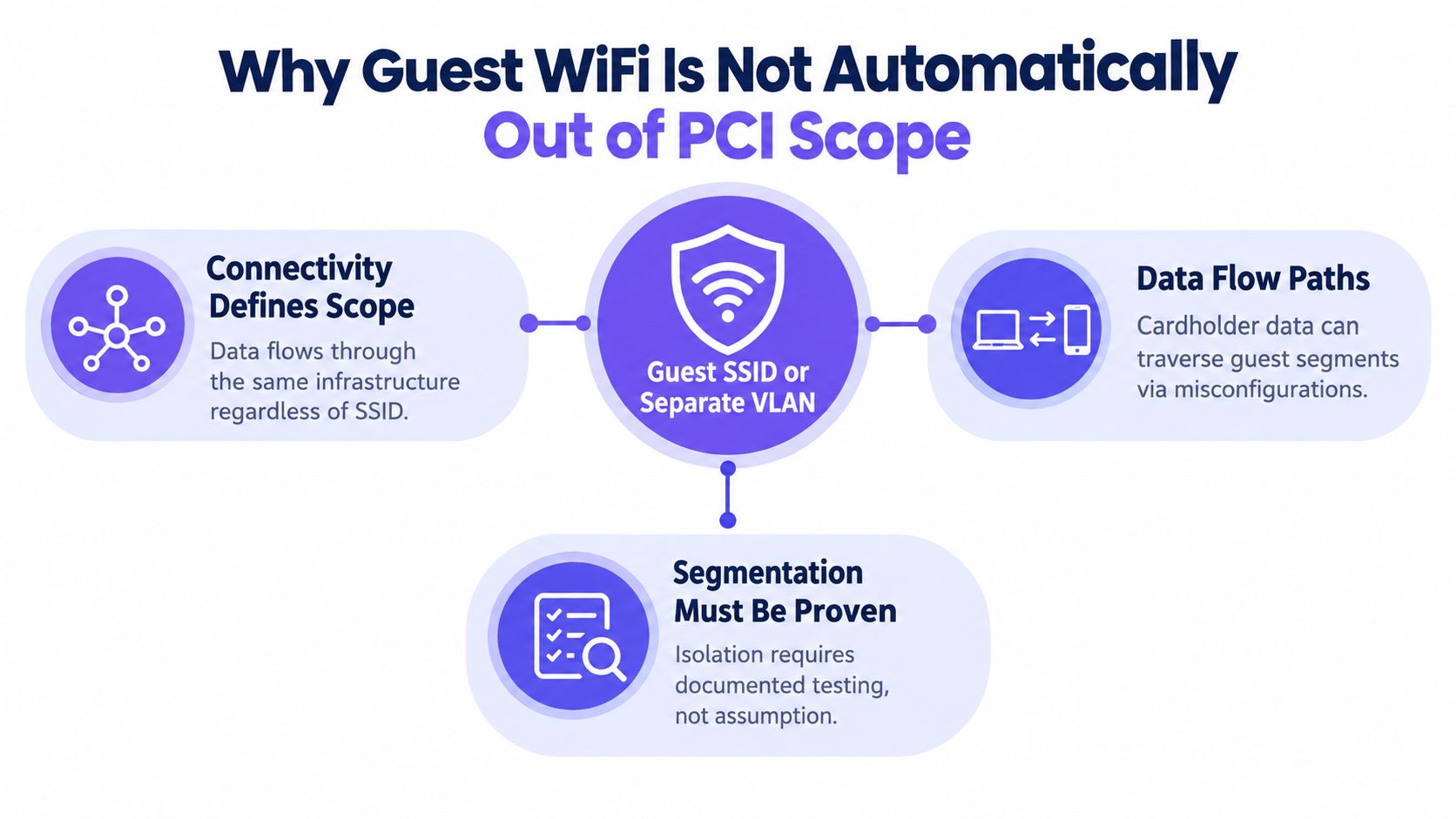
A separate guest SSID does not make Wi-Fi safe by default, and a separate VLAN does not solve it either. PCI scope is removed only when wireless is segmented from the cardholder data environment and that separation is enforced in the path, not just in the label. PCI DSS 4.0.1 requires network security controls between all wireless networks and the CDE, with wireless traffic denied by default and only business-justified traffic permitted (PCI Wireless Guidelines).
The label on the SSID is not the control
A compromised access point, controller, or switch can still bridge into the payment network if the route exists. “Guest Wi-Fi” is a description of intent. It is not a control an assessor can verify.
Practical rule: if you cannot show where traffic stops, you have not shown segmentation.
The hard part is proving isolation. PCI guidance also warns against assuming wireless is harmless just because payment systems are not intentionally connected to it, and it requires periodic verification that unauthorized wireless technology has not been introduced.
What decides scope
The question is direct: can any traffic path from that wireless network reach the CDE? If it can, the network is in play. If it cannot, you still need evidence that the block is real, enforced, and monitored.
That evidence matters more in multi-site environments where access points, switches, firewalls, cameras, tills, and staff devices share the same fabric. A neat SSID name will not help if routing, controller policy, or a shared switch uplink leaves a hidden path open. A useful comparison is Purple Access's three-SSID approach, which treats identity and network role as separate from the SSID label itself.
Proving Wireless Segmentation With Evidence the Assessor Will Accept
Segmentation counts only when you can prove it on the wire. Start with the firewall, not the dashboard. PCI guidance expects segmentation controls to block traffic between wireless networks and the CDE, and it requires segmentation to be penetration-tested at least annually, and again after significant network, firewall, controller, VLAN, identity, or payment-application changes.
Build the evidence chain
Use the same evidence pattern every time, so the assessor sees a repeatable control, not a one-off screenshot. Attach the AP inventory snapshot used for the test, then show the firewall, switch, and controller state at the moment of testing. Compare that against controller data, switch data, DHCP records, and wireless intrusion detection results on a regular basis. For switch-side validation, IT Cloud Global's network switch advice is a useful reference.
A firewall rule on paper is not enough. You need proof that the deployed path blocks traffic.
Negative tests matter. Test for rogue AP bridging, unauthorized client association, VLAN hopping, weak administrative access, and accidental access to payment terminals. If a test only confirms that the rule exists, it is not a segmentation test. It is a configuration screenshot.
What to verify before and after changes
A network change can invalidate clean evidence overnight. Re-run the tests after controller updates, firewall changes, VLAN redesigns, identity changes, or payment-app changes. Do not wait for annual audit season to find drift.
If you want a practical way to think about switch and controller hygiene, the guidance at three-SSID wireless segmentation design is a useful companion, because the same operational discipline applies to segmentation evidence. The point is to show that routing, switching, and firewall policy line up with the intended isolation.
When you write this up for an assessor, keep the artifacts together, test plan, test results, remediation notes, and retest evidence. That bundle turns "we think it is isolated" into "we proved it."
Choosing the Right Authentication Model for PCI Wireless
Shared passwords are the weakest acceptable answer, and usually the easiest to break under real operations. Staff change. Contractors leave. Concessions rotate. A PSK that lives too long becomes a liability, even if the wireless signal itself is segmented. For PCI environments, authentication has to support unique access, targeted revocation, and clean identity mapping.
Here's the direct comparison.
| Model | Shared Secret Risk | Per-Device Revocation | Identity to VLAN Mapping | PCI 4.0.1 Fit |
|---|---|---|---|---|
| Shared PSK | High, one secret is shared across many users or devices | Weak, changing one user usually means changing the whole key | Limited, identity is blurred | Poor for staff and operational networks |
| WPA2-Enterprise with EAP-TLS | Low, credentials are tied to certificates on devices | Strong, one certificate can be revoked without rebuilding the WLAN | Strong, RADIUS can map users and devices to policy | Strong fit for staff access |
| Per-device xPSK | Lower than shared PSK, each device or tenant gets its own key | Strong, one key can be removed without affecting others | Good, identity can drive policy and revocation | Strong fit for BYOD, IoT, concessions |
WPA2-Enterprise with EAP-TLS is the cleanest model for staff. It gives you certificate-based trust and removes the shared-secret mess that auditors hate. For BYOD, IoT, or concession devices, per-device or per-tenant xPSKs are a better operational fit, because you can revoke one device without tearing down the whole network.
Operational rule: if you can't revoke one device without changing everyone else's access, the model is too blunt.
For identity-based design, Purple Access's identity-based networking page is worth reviewing because it frames wireless access around user and device identity rather than around a single shared credential. That's the right mental model for pci compliance wifi in a multi-site estate.
Guest Wi-Fi should stay on a dedicated path with no route to the CDE. Staff access should use certificates. Everything else should be explicit, revocable, and auditable.
Identity Driven VLANs, Cloud RADIUS, and Strong Cryptography
Authentication only helps when RADIUS maps identity to the correct segment. In PCI wireless design, the control path runs from identity store to RADIUS to VLAN to firewall policy, and each handoff needs to be verifiable.
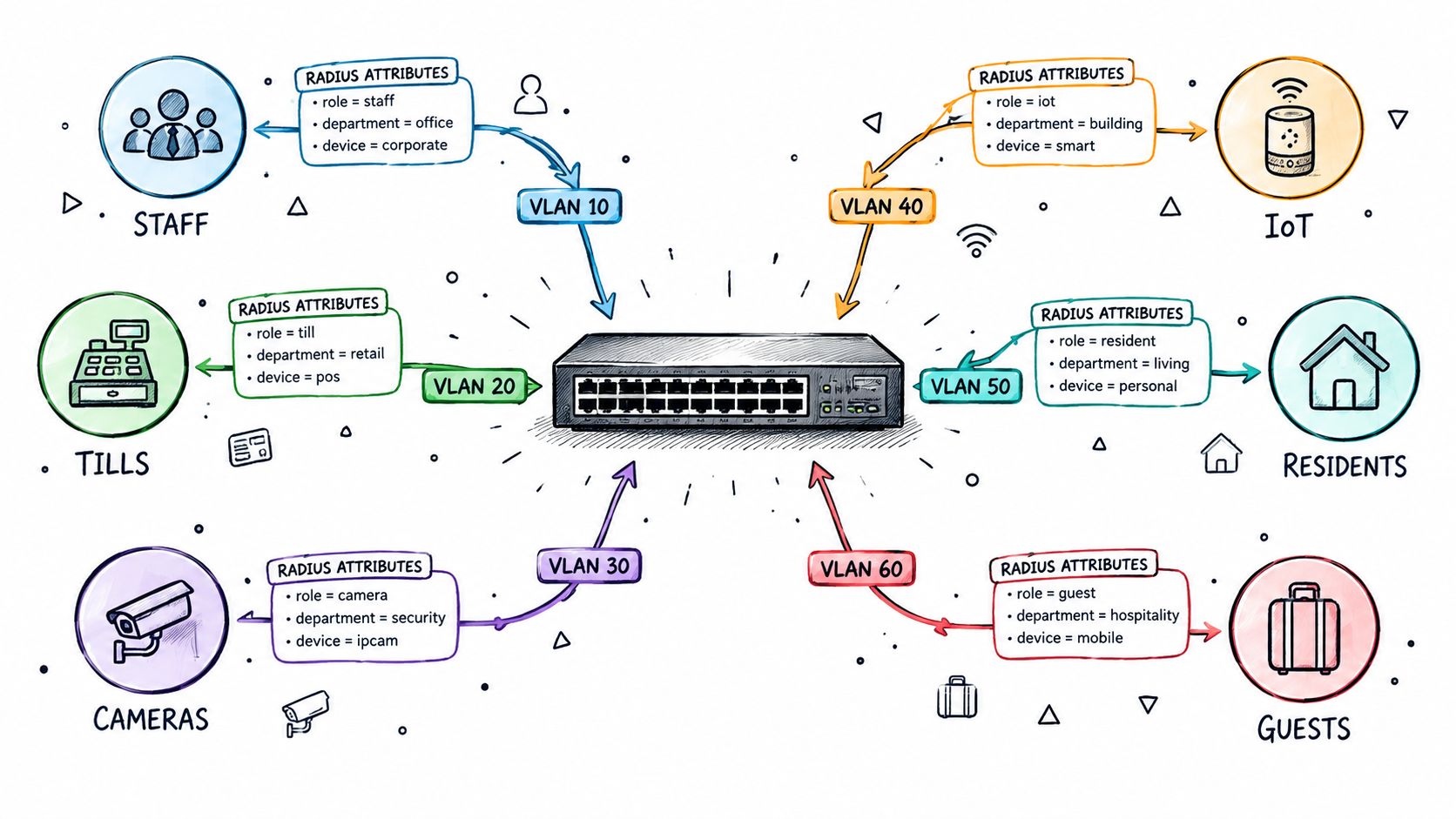
Identity has to land in the right place
Directory-backed provisioning through systems like Entra ID, Okta, or Google Workspace keeps joiners, movers, and leavers aligned with policy. If identity changes but VLAN assignment does not, the network still treats the old user as if nothing changed.
For the underlying switching layer, see VLAN setup for small business, which covers the trunk and access-port configuration that carries these RADIUS-assigned segments.
Cloud RADIUS fits this model when you need consistent authentication across regions or sites. Purple Access's Cloud RADIUS ties identity-driven routing to the right SSID and VLAN, with audit logging and revocation support. That keeps wireless access tied to current identity, not static MAC lists.
Strong cryptography is part of the scope story
PCI wireless guidance treats wireless networks as public networks for cardholder-data transmission, so PAN traffic needs strong cryptography such as TLS, IPsec, or WPA2-AES (PCI Wireless Guidelines). “Secured Wi-Fi” is not the same thing as compliant Wi-Fi. The crypto choice has to match the data moving across the link.
Certificate-based onboarding through MDM keeps private keys off shared passwords and gives staff devices a cleaner trust model. For mixed estates, use certificates for employees, xPSKs for devices that cannot run full enterprise auth, and guest access on a path that never reaches payment systems.
Logging, Monitoring, and Rogue Access Point Detection
A written no-Wi-Fi policy does not remove the rogue-detection obligation. PCI expects organizations to manage both authorized and unauthorized wireless access points, so the control has to be active, not just documented.
The monitoring cycle that works
Start with an approved AP inventory, then treat it as a live control record. Include owner, location, hardware address, SSIDs, controller, firmware, and whether the AP can reach the CDE. Run the inventory comparison on a fixed weekly cadence and retain the diff output, because the assessor will ask when the last comparison ran and what it found.
Compare that inventory against controller data, switch data, DHCP data, and wireless intrusion detection output. Then look for drift: a new BSSID, a moved device, a firmware mismatch, or an AP that appears on one source but not the others.
If you see an unknown BSSID, investigate it. Validate the device physically, classify it, and quarantine or remove it if it is unauthorized. Keep the alert, the investigation notes, and the remediation evidence. The assessor wants a clear trail, not a sentence that says someone handled it.
A practical wireless monitoring cycle should look like this:
- Inventory first: keep the approved list current, including ownership and placement.
- Cross-check on schedule: compare controller, switch, DHCP, and WIDS data every week.
- Escalate unknowns: investigate any BSSID or AP that does not match the inventory.
- Validate in person: confirm the device physically before you classify it.
- Remediate and retain: quarantine or remove the device, then keep the alert trail and comparison output.
Don't forget the diagramming standard
Wireless diagrams should show security-control placement and all relevant connections, including out-of-scope WLANs. An assessor needs to see how the wireless fabric relates to the CDE, not just where the SSIDs broadcast.
If your monitoring only reports what you intended to deploy, it will miss what appeared on the floor.
Remediation Playbook for the Most Common Wireless PCI Findings
Most wireless findings repeat because teams fix symptoms instead of control failure. They restore a diagram, change a password, or patch a controller, then stop before the evidence chain is rebuilt. That's why the same issues keep showing up across multi-site audits.
Fix the failure, then prove the fix
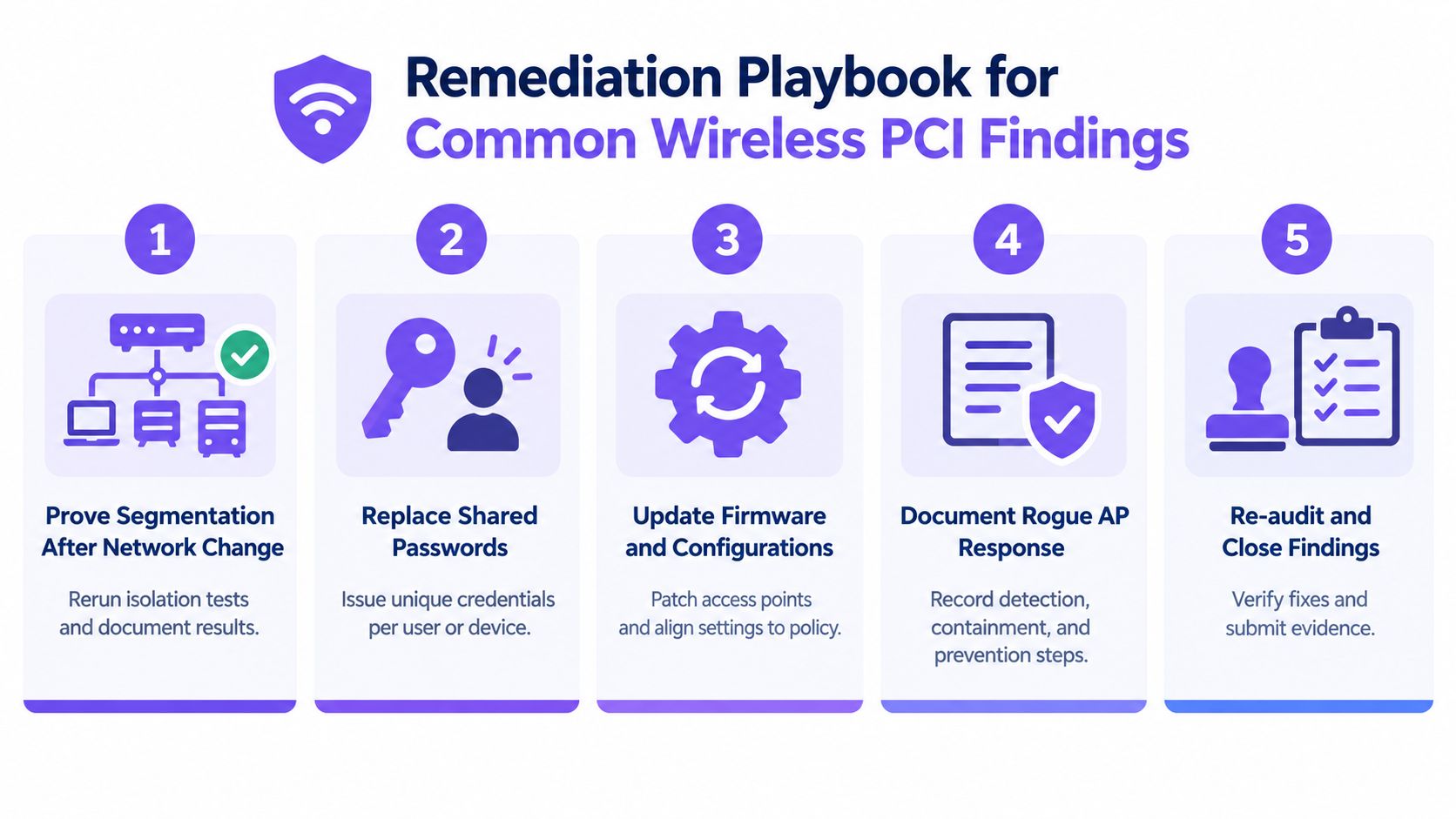
If segmentation failed after a network change, rerun the isolation tests and capture the result. If staff still share a password, move them to certificates or per-device keys. If controller or switch configs drifted, patch them back to policy and store the new snapshot with a date trail.
A weak administrative path on the controller or switch needs the same treatment. Close it, then prove it's closed from the same vantage point an attacker would use. The assessor won't care that the intended ACL exists if the live path still leaks.
Prioritize the backlog by audit impact
- Prove segmentation after any network change. This is the highest-value fix because it addresses the core PCI question, can wireless reach the CDE?
- Replace shared passwords. Shared access is hard to revoke cleanly and easy to mishandle at scale.
- Update firmware and configurations. Drift is where yesterday's compliant design becomes today's exposure.
- Document rogue AP response. If the response isn't recorded, the control looks imaginary.
- Re-audit and close findings. Every fix needs retest evidence, or it isn't closed.
The best remediation evidence is boring. It shows the change, the test, the result, and the date. That's what auditors trust.
What Assessors Ask About Wireless
Guest Wi-Fi does not remove PCI scope by itself. Assessors look for proof that wireless traffic cannot reach the CDE in practice, not just on a network diagram.
They want evidence, not labels. That means firewall rules, routing reviews, controller and switch snapshots, packet tests, and logs that show traffic is blocked or confined as designed. A separate SSID is only useful if the live path supports it.
They also check the retest trail. Wireless segmentation testing should be repeated after significant network, firewall, controller, VLAN, identity, or payment-application changes, and the assessor will expect to see the latest retest evidence.
After a controller or firewall change, rerun the wireless tests and keep the before-and-after results together. If the control changed, the evidence has to change with it.
Multi-site setups draw extra scrutiny. Shared infrastructure can blur guest, staff, and payment traffic, so assessors usually ask for identity mapping, segmentation evidence, and live monitoring across sites. They also commonly request the last three rogue-AP investigation records and proof that the most recent firewall change was retested.
Purple Access helps model wireless access around identity, segment users and devices with RADIUS-driven policy, and keep audit evidence in one place. If you are tightening pci compliance wifi across multiple sites, visit Purple Access and review how its Cloud RADIUS, xPSK, and evidence tooling fit into a controlled wireless design.