
Secure network: certificates, identity and PasspointAuthentication
Multi-tenant RADIUS for MSPs: isolating customers on one platform
Decide which cloud RADIUS model fits each MSP customer. Give a Purple tenant per customer when identity providers, owners or audits differ. Use a shared tenant, segmented by realm and VLAN, for single-owner groups with one directory. Then plan each migration as a weekend exercise on the access points your customers...
13 min read
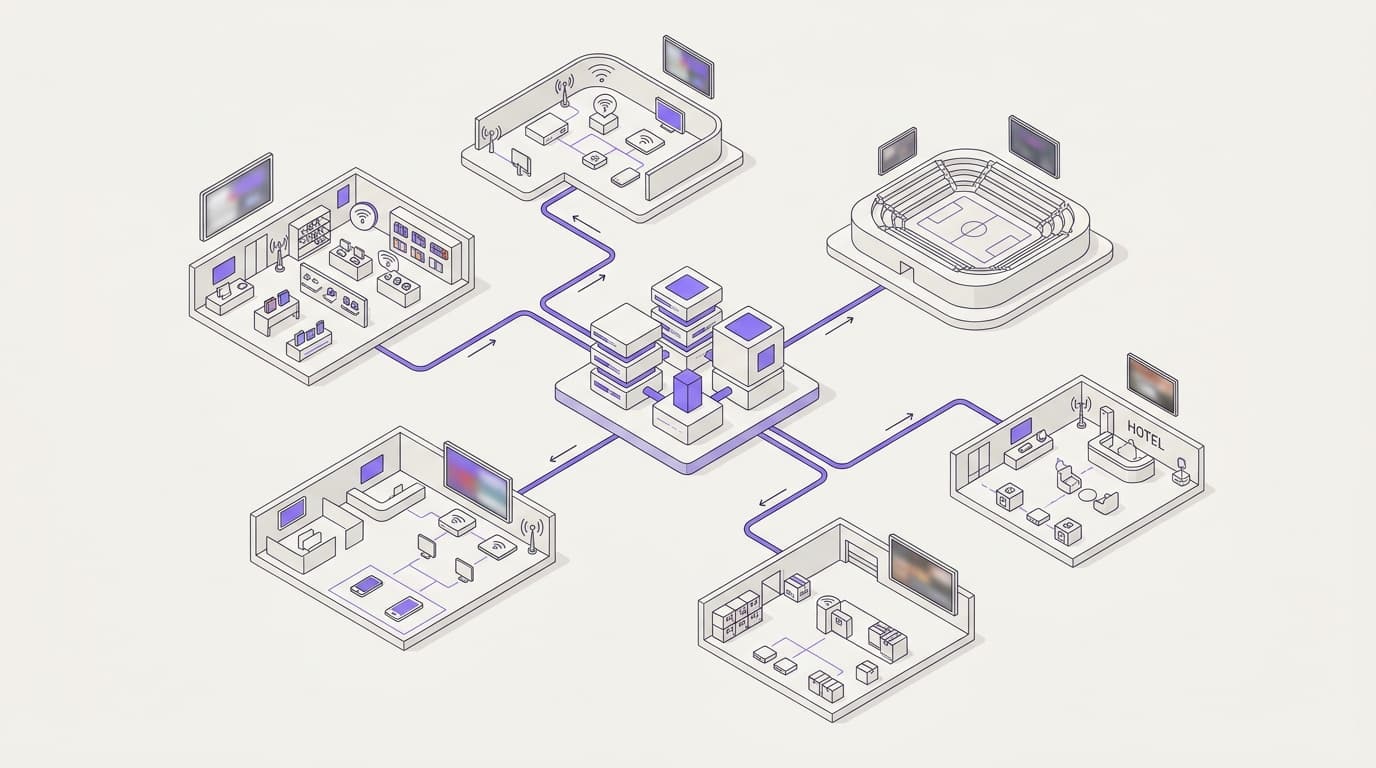
Watch the explainer
Use one Purple tenant per customer when customers run separate identity providers or face separate audits. Use one shared tenant, segmented by realm and VLAN, when every site belongs to one group with one directory. Both run on the largest cloud RADIUS in the world, with a 99.9% RADIUS uptime SLA. Neither needs new access points.
Which RADIUS model should an MSP use for multi-tenant WiFi?
The rule of thumb is simple to state. Give every customer its own tenant on one cloud RADIUS platform. Isolation should follow the identity and legal boundary, not the hardware boundary.
RADIUS (Remote Authentication Dial-In User Service, defined in RFC 2865) is the protocol your access points use to ask two questions. May this device join? Which VLAN (virtual LAN, a logically separate network segment) should it land on? IEEE 802.1X is the standard that carries those questions from the access point to the RADIUS server.
Answering them once is easy. The hard part for an MSP is answering them for 40 customers at once. No customer's policy, identities or logs may leak into another's.
Four things must stay separate for each customer:
- Identity source. Each customer's own directory, such as Microsoft Entra ID, Okta or Google Workspace.
- Policy. The rules that decide who joins and which VLAN they get.
- NAS clients and shared secrets. A NAS (network access server) is the access point or controller that sends RADIUS requests. Each one authenticates to RADIUS with a shared secret.
- Evidence. Authentication and accounting logs (RFC 2866) that an auditor can read for one customer without seeing another.
This decision sits on the secure network: EAP-TLS, identity provider integration, Passpoint and cloud RADIUS. EAP-TLS (RFC 5216) authenticates devices with certificates rather than passwords. For the wider picture, see the secure network guide to certificates, identity and Passpoint.
Three scenarios bend the rule:
- One owner, many sites. When every site shares one owner and one directory, a shared tenant with per-site VLANs is less work.
- Residents rather than staff. When the people connecting are residents, the xPSK network carries the load.
- Several audit scopes in one customer. When one customer holds two audit scopes, you may split that customer in two.
How do you choose a tenant model in one chart?
Work through three questions per customer, not per estate. An MSP book usually contains both tenant models.
{"title":"Choosing a RADIUS tenant model for each MSP customer","start":"q1","nodes":[{"id":"q1","question":"Do all of this customer's sites share one owner and one identity provider?","help":"One Microsoft Entra ID, Okta or Google Workspace directory, and one legal entity or group.","options":[{"label":"Yes","to":"q2"},{"label":"No","to":"q3"}]},{"id":"q2","question":"Does any site hold a separate audit scope, such as PCI DSS cardholder data?","help":"Ask whether an auditor needs evidence for one part of the estate in isolation.","options":[{"label":"Yes","to":"o1"},{"label":"No","to":"o2"}]},{"id":"q3","question":"Are the people connecting residents in their own homes rather than staff?","help":"Multi-Family, student housing and other multi-dwelling units.","options":[{"label":"Yes","to":"o3"},{"label":"No","to":"o1"}]},{"id":"o1","outcome":"Tenant per customer on Purple cloud RADIUS","detail":"Separate identity source, policy, NAS clients and logs. Use EAP-TLS for staff devices.","link":"[Cloud RADIUS for multi-site estates](guide:cloud-radius-multi-site)"},{"id":"o2","outcome":"Shared tenant with realm and VLAN segmentation","detail":"One directory and one policy. RADIUS returns a VLAN per site or group.","link":"[One policy across every location](guide:cloud-radius-multi-site)"},{"id":"o3","outcome":"Tenant per operator with an xPSK key per resident","detail":"Each resident's key sets their VLAN. Keep staff on the secure network in the same tenant.","link":"[Sequencing a multi-site migration](guide:radius-migration-multi-site)"}]}
Which tenant model fits which customer estate?
The scenario table covers the estates MSPs meet most often. Read the "why" column first. It names the condition each recommendation depends on.
{"caption":"Tenant model by customer estate","asOf":"2026-06-10","columns":[{"key":"scenario","label":"Scenario"},{"key":"rec","label":"Recommendation","highlight":true},{"key":"why","label":"Why"}],"rows":[["Independent hotels, each with its own directory","Tenant per customer","Separate identity providers and separate owners"],["Multi-academy trust on one Microsoft Entra ID","Shared tenant, VLAN per school","One directory; group membership sets the VLAN"],["Retail chain with PCI DSS card terminals","Tenant per customer, payment devices on their own VLAN","Keeps cardholder-scope evidence inside one tenant"],["Hotel group with several brands and one directory","Shared tenant, realm or group per brand","One owner and one directory; brands differ only in policy"],["Multi-Family or Student Housing operator","Tenant per operator, xPSK key per resident","Each resident's identity sets their own VLAN"],["Public bodies sharing one building and its network","Tenant per body","Each body is a separate CCPA/CPRA data controller"],["Venue operator running staff WiFi at events","Tenant per operator, temporary staff via the IdP","Joiners and leavers follow the operator's directory"],["Customer adding Passpoint for staff roaming","Tenant per customer with its own certificates","Credentials must not be trusted across customers"],["Small customer with one or two sites","Tenant per customer","Low onboarding effort and no rework if it grows"]],"footnote":"Recommendations assume IEEE 802.1X on existing access points. Guest access on the open network is out of scope here.","download":{"filename":"msp-radius-tenant-models.csv"}}
Tenant per customer: when does hard isolation earn its keep?
A tenant per customer gives each customer its own identity source, its own policy, its own NAS clients and its own logs. Nothing is shared except the platform underneath. This is the multi-tenant RADIUS model most MSPs should start from.
It fits when any of three conditions holds:
- Different identity providers. Customer A runs Microsoft Entra ID and customer B runs Google Workspace. One shared policy cannot serve two directories cleanly.
- Different owners. Two customers are separate legal entities, each with their own CCPA/CPRA obligations and their own right to leave you.
- Separate audits. Each customer will be audited on its own. An auditor wants evidence for one estate without reading another's records.
It does not fit when you would create 12 tenants for 12 sites of one organization. That multiplies policy without adding isolation.
{"kind":"flow","direction":"lr","caption":"How one RADIUS request stays inside one customer's tenant","alt":"An access point sends an 802.1X request to Purple cloud RADIUS, which handles it inside the customer's tenant, checks the customer's identity provider and returns a VLAN.","nodes":[{"id":"ap","label":"Customer access point","sub":"Cisco Meraki, HPE Aruba, Ruckus, Juniper Mist or Ubiquiti UniFi","tone":"neutral"},{"id":"rad","label":"Purple cloud RADIUS","sub":"One platform, many tenants","tone":"brand"},{"id":"ten","label":"Customer tenant","sub":"Own NAS clients, secrets, policy and logs","tone":"brand"},{"id":"idp","label":"Customer identity provider","sub":"Microsoft Entra ID, Okta or Google Workspace","tone":"neutral"},{"id":"vlan","label":"VLAN returned","sub":"Device lands on the right segment","tone":"success"}],"edges":[{"from":"ap","to":"rad","label":"802.1X request"},{"from":"rad","to":"ten","label":"Handled in one tenant"},{"from":"ten","to":"idp","label":"Identity check"},{"from":"ten","to":"vlan","label":"Accept with VLAN"}]}
What you configure on the access points
You change settings on the existing hardware; you do not replace it.
- Cisco Meraki. In the Meraki Dashboard, set the SSID's access control to Enterprise with my RADIUS server. Then enable RADIUS override so the VLAN in the response applies.
- HPE Aruba, Juniper Mist, Ruckus and Ubiquiti UniFi. The equivalent is an Enterprise (802.1X) WLAN pointing at the RADIUS servers listed in that customer's tenant.
Take server addresses and shared secrets from the tenant itself, never from another customer's configuration.
Worked scenario: 24 independent hotels
Situation. An MSP manages Staff WiFi for 24 independent hotels on Cisco Meraki. Fifteen hotels run Microsoft Entra ID and nine run Google Workspace. Each hotel had its own Windows Network Policy Server virtual machine and its own certificate.
What was done. The MSP created one Purple tenant per hotel. It connected each tenant to that hotel's identity provider and moved staff devices to EAP-TLS. It then repointed each SSID in the Meraki Dashboard. Hotels moved in weekend batches, because RADIUS migration is usually a weekend exercise.
Outcome. The MSP went from 24 RADIUS servers to patch, back up and fail over to none. Departure processing in Entra ID or Google Workspace no longer depends on a server's directory sync. Each hotel's logs sit in its own tenant, ready as evidence for its own audit.
Shared tenant with realm and VLAN segmentation: when does one group need only one tenant?
A shared tenant serves several sites from one policy and one directory. RADIUS still separates the sites. It does so with VLAN assignment, not with separate tenants.
Two standards do the work:
- VLAN attributes. RFC 3580 defines the RADIUS attributes that tell the access point which VLAN to apply: Tunnel-Type, Tunnel-Medium-Type and Tunnel-Private-Group-ID.
- Realms. RFC 7542 defines the realm, the part of an identity after the @ sign. The realm can mark which brand or entity a person belongs to.
The policy reads directory group membership or realm, then returns the matching VLAN. Identity sets the VLAN, so a member of staff who moves between sites needs no new credential.
This model fits when three conditions hold together:
- One owner.
- One identity provider.
- No part of the estate needs isolated audit evidence.
Break any one of them and you move to a tenant per customer.
{"tone":"warning","title":"Never share secrets or directories across owners","text":"Reusing one RADIUS shared secret across customers means one leak exposes every customer's traffic. Putting two owners' directories in one tenant invites username collisions and cross-customer policy errors."}
Worked scenario: a 12-school district
Situation. An MSP supports a school district of 12 schools on HPE Aruba. Every member of staff sits in one Microsoft Entra ID directory. Each school ran its own pre-shared key (PSK) staff SSID, so the MSP had 12 keys to rotate whenever someone left.
What was done. The MSP created one shared Purple tenant for the district and moved staff devices to IEEE 802.1X with EAP-TLS. The policy returns a VLAN per school based on Entra ID group membership. Each school's Aruba WLAN points at the same tenant.
Outcome. Twelve shared keys were retired and replaced by one policy. A teacher who moves school changes group in Entra ID and lands on the new school's VLAN at their next connection. Leavers lose access through the directory, not through a key change at every site.
What does each model cost to run?
Running cost for MSP RADIUS is mostly engineer time, not licenses. The table compares both Purple models with the baseline many MSPs run today: a self-hosted RADIUS server per customer.
{"caption":"Running cost and effort by RADIUS model","asOf":"2026-06-10","columns":[{"key":"line","label":"Cost line"},{"key":"self","label":"Self-hosted server per customer"},{"key":"tpc","label":"Purple tenant per customer","highlight":true},{"key":"shared","label":"Purple shared tenant","highlight":true}],"rows":[["Servers to build and patch","One or two per customer","None","None"],["Failover","Second server per customer, built and tested by you","99.9% RADIUS uptime SLA","99.9% RADIUS uptime SLA"],["Platform uptime","Your own hosting design","Platform runs at 99.999%","Platform runs at 99.999%"],["Identity sources","Connector or domain join per server","One IdP per tenant","One shared directory"],["Policies to maintain","One per server","One per customer","One per group, with per-site rules"],["Onboarding a new customer","Build, harden and test a server","Create a tenant, connect the IdP, repoint SSIDs","Add the site to the existing policy"],["Offboarding handling","Manual unless the server syncs the directory","Follows the customer's IdP","Follows the group's IdP"],["Audit evidence","Logs spread across servers","Logs and policy per customer","Shared logs, filtered by site"],["Migration effort","Baseline: nothing to migrate","Usually a weekend exercise per customer","Usually a weekend exercise for the group"],["New hardware","None","None: hardware-agnostic","None: hardware-agnostic"]],"footnote":"SLA, uptime and migration figures are Purple's own. Self-hosted figures describe the typical design, not a benchmark.","download":{"filename":"msp-radius-running-cost.csv"}}
The self-hosted model isolates customers by duplication. Every new customer adds a server, a certificate, a backup job and a failover test. The cost grows in a straight line with your book of business.
A tenant per customer keeps the isolation and drops the duplication. The shared tenant is cheaper again, but only inside one owner's estate.
To put license numbers against these lines, follow the cloud RADIUS pricing model per site and per user.
{"tone":"proof","title":"Scale you can point a customer to","text":"Chase runs Staff WiFi on Purple across 5,000 branches. Purple runs in 80,000+ venues in 90 countries."}
What changes the answer?
The rule of thumb holds for most customers. These conditions move a customer from one model to the other, or add a second network alongside the secure one.
Your customer runs more than one identity provider
Mergers leave groups with two directories, often Microsoft Entra ID and Google Workspace. A shared tenant can serve both, but policy gets harder to read and audit. Split by owner where the directories map to separate entities. Keep one tenant where they are one entity mid-migration.
An auditor wants separate evidence
PCI DSS requires that segmentation be tested. A retail customer with card terminals should keep those devices on their own VLAN, with policy and logs that show it.
A tenant per customer gives you evidence for that segmentation test without exposing other customers' records. Purple holds ISO 27001 certification. Your customer's own audit outcome remains theirs to earn.
The people connecting are residents, not staff
Multi-Family, Student Housing, and other MDU (multi-dwelling unit) operators need each resident on their own network segment. Use the xPSK network: iPSK (identity pre-shared key) gives each resident or device its own key, and that key sets the resident's VLAN.
Staff on the same property stay on the secure network, inside the same operator tenant.
You are adding Passpoint or OpenRoaming
Passpoint (Hotspot 2.0) lets devices join automatically with a stored credential. OpenRoaming extends that across federated networks.
Credentials and certificates must never be trusted across customers. That makes a tenant per customer the only sound choice once roaming enters the design.
The site's WAN link is fragile
Cloud RADIUS needs a path from the access point to the platform. Plan for WAN loss on remote sites before cutover, whichever tenant model you choose. See what happens to WiFi when RADIUS is unreachable for recovery steps.
Guest access and DNS filtering
Guest access belongs on the open network behind a captive portal, the sign-in page a visitor sees before getting online. Guest marketing sits in Engage and DNS filtering sits in Shield. Neither changes the tenant decision for staff RADIUS.
What is the recommended default for MSPs?
Default to one Purple tenant per customer. Move a customer to a shared tenant only when all its sites share one owner, one directory and one audit scope.
{"title":"Tenant per customer or shared tenant","options":[{"name":"Purple tenant per customer","fitsWhen":["Customers are separate legal entities","Customers run different identity providers","Each customer is audited on its own","Passpoint or OpenRoaming is planned"],"notWhen":["Every site belongs to one owner with one directory"]},{"name":"Purple shared tenant with VLAN segmentation","fitsWhen":["One owner and one identity provider","Sites differ only in VLAN and local policy","Staff move between sites"],"notWhen":["Any site holds a separate audit scope","A second owner joins the property"]}],"recommendation":"Start every new MSP customer on its own Purple tenant. Use a shared Purple tenant only for single-owner groups with one directory and one audit scope."}
{"tone":"tip","title":"The default in one line","text":"One customer, one tenant, one identity provider, EAP-TLS for staff devices. Collapse to a shared tenant only when owner, directory and audit scope are all single."}
The first action is an inventory. List every customer, its identity provider, its access point vendor and its audit obligations. That list sorts your book into the two models in an afternoon.
Then pick the customer with the fewest sites and migrate it first. The multi-site RADIUS migration guide covers sequencing. The Purple cloud RADIUS product page covers what the platform includes. For the wider control set, read the enterprise WiFi security guide.
Frequently asked questions
How is multi-tenant cloud RADIUS priced for an MSP?
You model it per site and per user, then compare it with what you run today. The comparison that matters is total running cost: servers, hosting, certificates, backup and engineer hours for each self-hosted RADIUS instance. Those costs grow with every customer you add. A tenant per customer on Purple removes the server lines entirely. Use the cloud RADIUS pricing guide to build the per-site and per-user model for your own book of business.
Does it work with the access points my customers already own?
Yes. Purple is hardware-agnostic and works with Cisco Meraki, HPE Aruba, Ruckus, Juniper Mist, Ubiquiti UniFi, Cambium, Extreme and Fortinet. Each vendor already supports IEEE 802.1X with an external RADIUS server, so you change SSID settings rather than hardware. On Meraki, that means Enterprise with my RADIUS server and RADIUS override. Other vendors call it an Enterprise (802.1X) WLAN.
How long does it take to migrate a customer off NPS or FreeRADIUS?
RADIUS migration is usually a weekend exercise per customer. You create the tenant and connect the customer's identity provider. Then you repoint SSIDs site by site, keeping the old server live until the last site cuts over. Larger estates move in batches across several weekends. The multi-site migration guide covers how to sequence sites, access points and policy without a gap in Staff WiFi.
Can one customer see another customer's users or logs?
No, provided you give each customer its own tenant. Identity source, policy, NAS clients and logs then sit inside that tenant. The cross-customer risk comes from shortcuts: a shared RADIUS secret, or two owners' directories in one shared tenant. Avoid both and isolation holds by design. Reserve shared tenants for single-owner estates.
Does a shared platform support PCI DSS or ISO 27001 audits?
It provides evidence for them; it does not pass the audit for your customer. A tenant per customer gives you per-customer policy and logs. These serve as evidence for segmentation testing under PCI DSS and for access control reviews under ISO 27001. Purple itself holds ISO 27001, Cyber Essentials and B Corp certification and supports CCPA/CPRA obligations. Each customer's own audit result remains theirs to achieve.
What happens to WiFi if cloud RADIUS cannot be reached?
New authentications fail until the path returns, so plan for it before cutover. Purple backs RADIUS with a 99.9% uptime SLA on a platform that runs at 99.999% uptime. The common failure point is the site's WAN link, not the platform. The RADIUS server down guide explains what devices do during an outage and how to recover quickly.
Can one customer run staff certificates and resident keys together?
Yes. The secure network and the xPSK network run side by side in one customer's tenant. Staff devices authenticate with EAP-TLS against the customer's identity provider. Residents each get their own iPSK key, and that key sets their VLAN. Multi-Family and Student Housing operators commonly need both. A single tenant keeps one set of logs and one place to manage joiners, movers, and leavers.
How does this compare with one FreeRADIUS server per customer?
A server per customer isolates by duplication; a tenant per customer isolates on one platform. With separate servers, you patch, back up, monitor, and fail over every instance yourself. Effort grows with each customer you sign. With Purple tenants, the platform runs on the largest cloud RADIUS in the world. Your engineers then spend their time on policy and onboarding rather than server upkeep.
Frequently asked questions
How is multi-tenant cloud RADIUS priced for an MSP?
You model it per site and per user, then compare it with what you run today. The comparison that matters is total running cost: servers, hosting, certificates, backup and engineer hours for each self-hosted RADIUS instance. Those costs grow with every customer you add. A tenant per customer on Purple removes the server lines entirely. Use the cloud RADIUS pricing guide to build the per-site and per-user model for your own book of business.
Does it work with the access points my customers already own?
Yes. Purple is hardware-agnostic and works with Cisco Meraki, HPE Aruba, Ruckus, Juniper Mist, Ubiquiti UniFi, Cambium, Extreme and Fortinet. Each vendor already supports IEEE 802.1X with an external RADIUS server, so you change SSID settings rather than hardware. On Meraki, that means Enterprise with my RADIUS server and RADIUS override. Other vendors call it an Enterprise (802.1X) WLAN.
How long does it take to migrate a customer off NPS or FreeRADIUS?
RADIUS migration is usually a weekend exercise per customer. You create the tenant and connect the customer's identity provider. Then you repoint SSIDs site by site, keeping the old server live until the last site cuts over. Larger estates move in batches across several weekends. The multi-site migration guide covers how to sequence sites, access points and policy without a gap in Staff WiFi.
Can one customer see another customer's users or logs?
No, provided you give each customer its own tenant. Identity source, policy, NAS clients and logs then sit inside that tenant. The cross-customer risk comes from shortcuts: a shared RADIUS secret, or two owners' directories in one shared tenant. Avoid both and isolation holds by design. Reserve shared tenants for single-owner estates.
Does a shared platform support PCI DSS or ISO 27001 audits?
It provides evidence for them; it does not pass the audit for your customer. A tenant per customer gives you per-customer policy and logs. These serve as evidence for segmentation testing under PCI DSS and for access control reviews under ISO 27001. Purple itself holds ISO 27001, Cyber Essentials and B Corp certification and supports CCPA/CPRA obligations. Each customer's own audit result remains theirs to achieve.
What happens to WiFi if cloud RADIUS cannot be reached?
New authentications fail until the path returns, so plan for it before cutover. Purple backs RADIUS with a 99.9% uptime SLA on a platform that runs at 99.999% uptime. The common failure point is the site's WAN link, not the platform. The RADIUS server down guide explains what devices do during an outage and how to recover quickly.
Can one customer run staff certificates and resident keys together?
Yes. The secure network and the xPSK network run side by side in one customer's tenant. Staff devices authenticate with EAP-TLS against the customer's identity provider. Residents each get their own iPSK key, and that key sets their VLAN. Multi-Family and Student Housing operators commonly need both. A single tenant keeps one set of logs and one place to manage joiners, movers and leavers.
How does this compare with one FreeRADIUS server per customer?
A server per customer isolates by duplication; a tenant per customer isolates on one platform. With separate servers, you patch, back up, monitor and fail over every instance yourself. Effort grows with each customer you sign. With Purple tenants, the platform runs on the largest cloud RADIUS in the world. Your engineers then spend their time on policy and onboarding rather than server upkeep.