Guest WiFi Marketing That Delivers Proven Results
Published

You're staring at a busy lobby, a portal that asks for too much, and a report that calls every connection a lead. Guests just want to get online. Your team wants emails it can actually use, and your network team wants fewer support complaints. When those goals don't line up, guest WiFi marketing becomes a crowded form, not a relationship.
Table of Contents
- Why Guest WiFi Marketing Needs a Better Foundation
- Build the Campaign Workflow in the Right Order
- Match the Program to Venue Behavior
- Turn Consent Into Useful Segments
- Attribute Results Without Overclaiming
- Protect Trust Privacy and Accessibility
- Launch Review and Improve the Campaign
Why Guest WiFi Marketing Needs a Better Foundation
A venue operator I work with described the problem plainly. The WiFi worked. People connected, bandwidth graphs looked healthy, and the database grew. Yet campaign results were flat, unsubscribes were uncomfortable, and nobody could say which contacts had agreed to marketing, which had only agreed to get online, and which should never have been mailed at all.
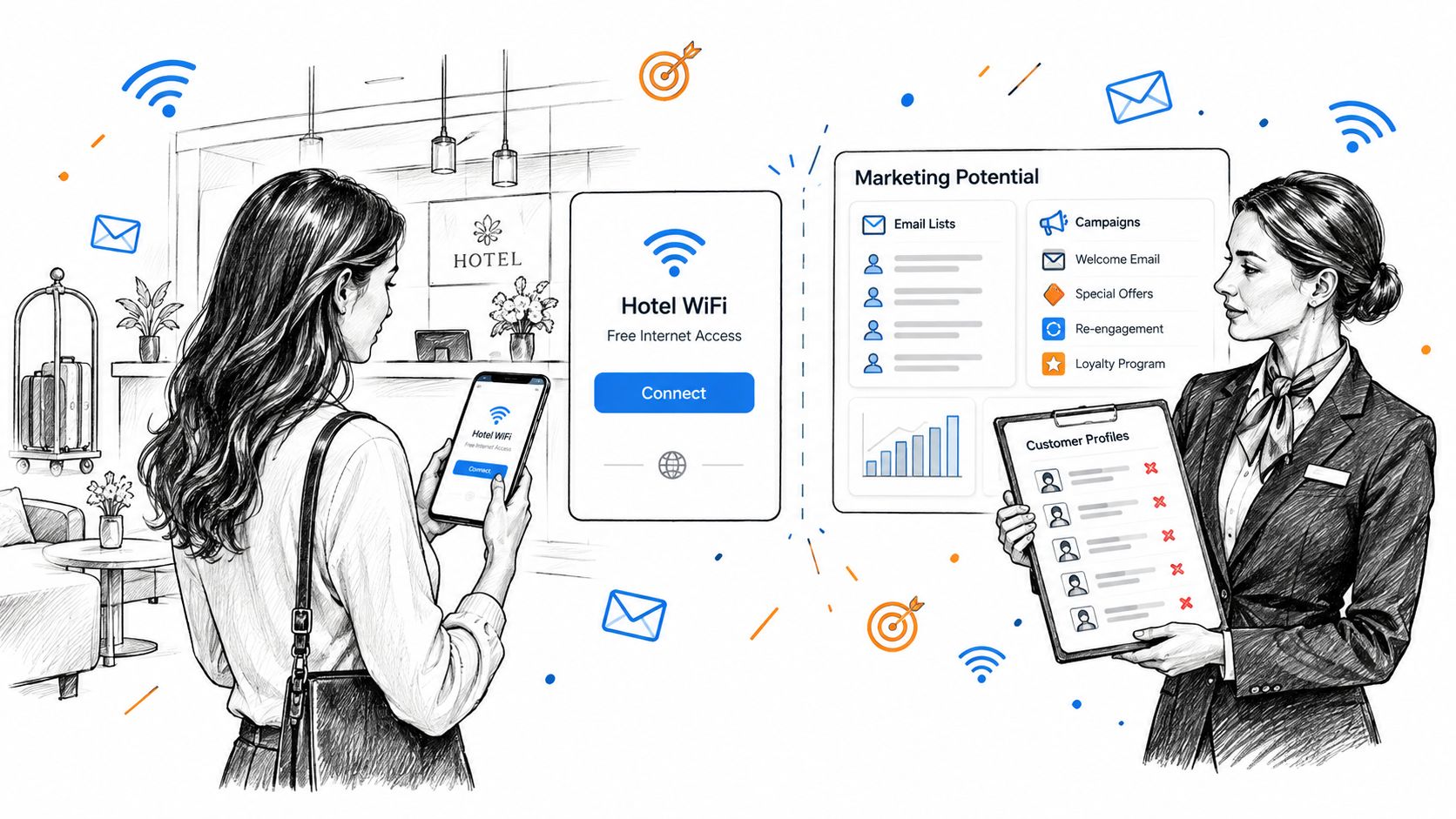
That gap is common because three different things get treated as one. Anonymous connectivity gets a device online. Identifiable access ties a session to a person or a verified contact method. Permissioned engagement adds a clear choice about future marketing, plus a record you can defend later. Only the third state gives you a marketing channel.
The form field trap
The usual fix makes things worse. A hotel adds date of birth to drive birthday offers. A shopping center adds zip code and interests. A restaurant adds phone number, email, and a loyalty question on the same screen. Each field sounds useful in a planning meeting, but the guest sees one long toll booth between them and the internet.
Completion quality drops first. People mistype, invent details, abandon the portal, or ask staff for help. Some complete the form without understanding what they've agreed to, which isn't a win. You've traded informed consent for nominal volume, and you'll pay for it later in deliverability, complaints, and messy segments.
Practical rule: Every field you collect needs a purpose, an owner, and a downstream action. If nobody can name all three, remove the field or make it optional.
Start from the visitor's job instead. They need fast, reliable connectivity in a place where cell signal may be weak, they're in a hurry, or they expect WiFi as part of the stay, meal, or ticket. Your exchange has to be proportionate. Access in return for authentication is one exchange. Ongoing offers, loyalty points, event updates, or useful local information in return for marketing consent is a second, separate exchange.
Keep those exchanges visually and legally separate. Required sign in fields should be the minimum needed to authenticate and operate the service safely. Optional marketing consent sits apart, unselected by default where required, written in plain language, and specific about channel and sender. A guest who declines marketing should still understand what happens next and shouldn't feel punished with a broken journey.
Design the record before the campaign
Before you write a welcome email, define the event record every connection will create. You don't need a data warehouse on day one, but you do need consistent fields you can join together later without guesswork.
- Venue and timestamp: Which site, zone if relevant, and when the connection happened.
- Authentication method: Email, SMS, social login, room validation, loyalty sign in, or another approved method.
- Consent status: What the person agreed to, the wording shown, and when that choice was made.
- Campaign exposure: Which message, offer, or landing page they saw, if any.
- Outcome identifier: A redemption code, booking reference, loyalty transaction, or other later signal you can match responsibly.
That structure turns a pile of logins into something you can segment, test, and audit. It also forces useful conversations early. Marketing has to say which downstream system receives the contact. Operations has to say who handles deletion requests. IT has to say how long authentication logs live compared with marketing profiles.
Purple Access and Purple Engage are useful context here because they separate those layers. A three SSID architecture for open, secure, and xPSK networks can support different access needs, while guest engagement and data capture can operate with or without Purple WiFi. Don't treat any single product path as mandatory. The portable decisions are the exchange, the consent wording, the fields, the retention period, and the systems each record flows into.
For operators reviewing the access layer itself, compare your current setup against modern guest WiFi solutions for physical venues and ask a blunt question. Does the portal explain itself to a tired traveler, a parent with one hand free, and a visitor using assistive technology, all within seconds?
Your pre-launch checklist
Write the visitor exchange in one sentence and test whether staff can explain it without jargon. Draft consent language a guest can understand on a small screen. List required fields, optional fields, and fields you'll collect later through loyalty or preference centers. Map each field to a system and a retention rule. Decide who owns completion rate, consent rate, data quality, and unsubscribe rate.
If you can't answer those points, you're not ready to argue about subject lines. You're still building the foundation, and that's exactly where proven results start.
Build the Campaign Workflow in the Right Order
Most programs fail from sequence, not effort. Teams launch an offer, then discover the portal doesn't record consent cleanly, segments can't be built, and redemptions can't be matched. Build the workflow in order and check each transition before you move on.
The visual below sets out the basic running order from connection events to targeted campaigns.
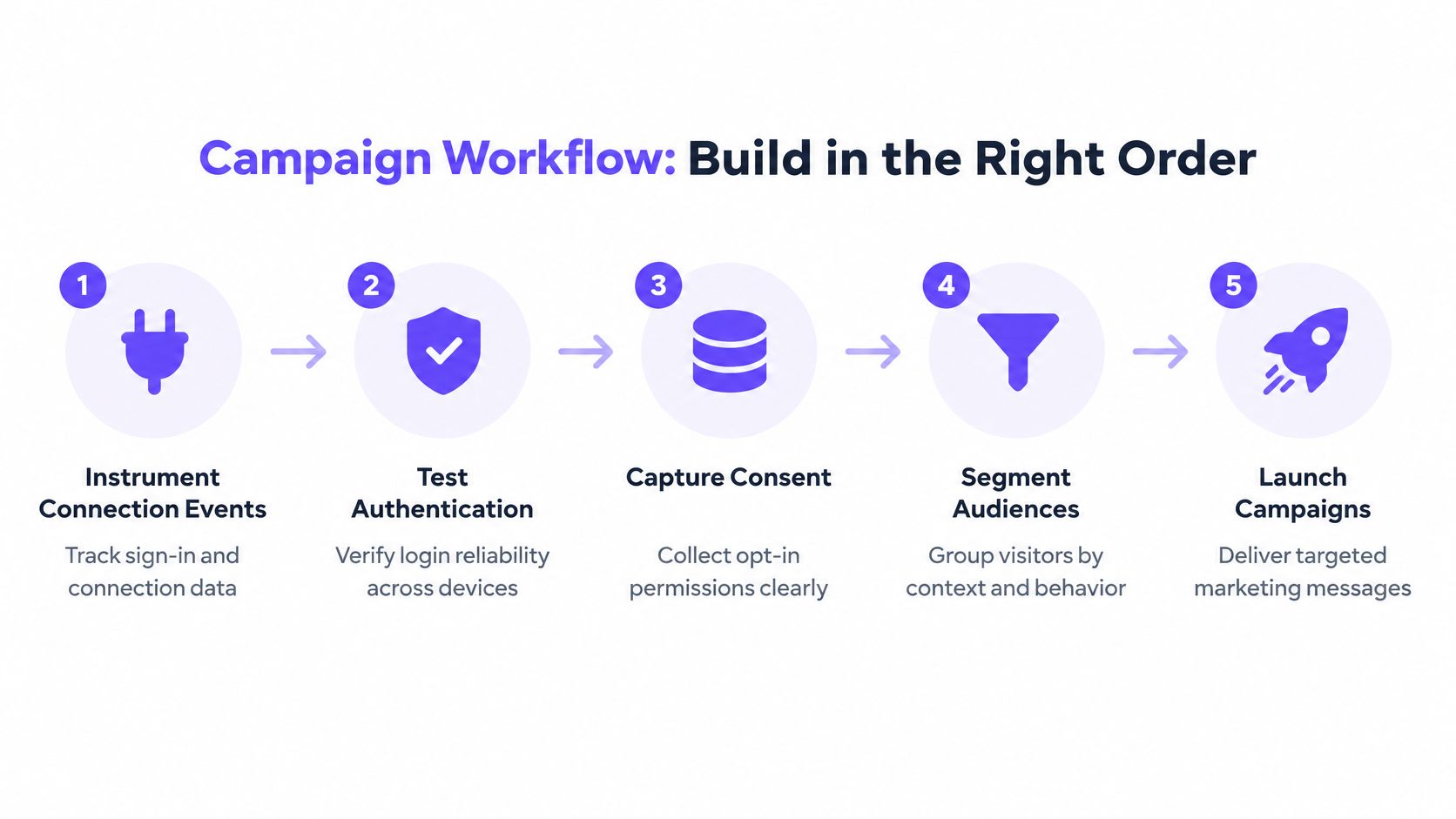
Start by instrumenting connection and sign in events. Record portal views, starts, completions, authentication success, and abandonment points. You need to know where people leave, not just how many finish. Test on the devices your guests carry, on slow connections, and with screen readers and enlarged text. A portal that works in the office can still fail in a basement food court.
Next, test authentication methods against the venue. Hotels can validate a room or reservation reference and link a consented record to a reservation identifier later. Restaurants may need a faster route that still separates dine in visitors from private event attendees. Retailers often need the lightest dependable method because dwell time is shorter and staff can't troubleshoot sign ins at the register.
Move from capture to activation
Only then should you finalize consent aware capture. Check that a person who opts out of marketing is suppressed downstream, that a person who opts in lands in the right system, and that duplicate visits don't create duplicate profiles every time. Run test records through email, SMS, CRM, and loyalty systems and watch where fields break.
Segmentation comes after that plumbing works. Build segments from visit context you captured, such as venue, first or repeat visit, authentication route, and campaign exposure. Connect each segment to one clear conversion event, whether that's a reservation, redemption, loyalty enrollment, or return visit. If a segment has no measurable next step, it's a label, not an audience.
This short walkthrough shows how operators think through the connection between access and engagement before activation.
Finish with a review rhythm. Give someone ownership of portal completion, someone ownership of consent quality, and someone ownership of campaign outcomes. Review them together, because a rise in opt-ins alongside a rise in complaints isn't progress. A retail operator comparing repeat visits by location, for example, needs the same definitions at every site before the comparison means anything.
Avoid prescribing identical infrastructure for every estate. A single independent venue and a multi site operator can follow the same sequence with different tools. The sequence is the discipline. It stops your team buying campaign features it can't measure and collecting data it can't lawfully or usefully activate.
Match the Program to Venue Behavior
A universal conversion target will mislead you. Guests behave differently when they're staying overnight, waiting for food, attending a conference, or passing through a store with strong cell signal. Dwell time, urgency, and the value of connectivity shape how much friction they'll tolerate.
Reported adoption gives useful context, not a promise. A 2025 industry survey cited in guest WiFi statistics and adoption reporting estimated guest WiFi marketing adoption at 72% in hospitality, 62% at events and conferences, 58% in restaurants, and 51% in retail, and the same reporting suggests only about 15 to 25% of in store traffic may log into a captive portal in well tuned retail deployments.
Email capture expectations also vary by setting. Vendor reported material in WiFi marketing and email capture benchmarks found 25.4% of businesses using guest WiFi identified email capture as their main goal, with reported capture at roughly 30 to 40% of WiFi connections in hotels, 25 to 35% in restaurants and bars, and 20 to 30% in retail.
| Venue context | Reported benchmark | Operational interpretation |
|---|---|---|
| Hotels | Email capture roughly 30 to 40% of connections | Longer stays support a clearer exchange, but guests still expect fast room based access. |
| Restaurants and bars | Email capture roughly 25 to 35% of connections | Waiting time helps, yet clumsy forms compete with ordering and conversation. |
| Retail | Email capture roughly 20 to 30% of connections, with portal logins around 15 to 25% of in store traffic | Short visits and strong cellular coverage reduce need, so value and speed matter most. |
| Events and conferences | Adoption reported at 62% | Attendees often need connectivity, but lines and session starts punish slow portals. |
Use the table to set questions, not targets carved in stone. How long do your guests wait? Is WiFi solving a real connectivity problem or is cell data good enough? Which languages do you need? Where exactly do visitors abandon, by device and by location?
Projections need the same caution. A venue with 50 WiFi connections per day could theoretically build a database exceeding 15,000 records annually at 80 to 85% capture, according to the email capture source above. Treat that as arithmetic, not a forecast. Repeat visitors, invalid details, consent quality, and privacy duties will reduce the usable audience, and that's fine. A smaller permissioned list beats a swollen list you shouldn't mail.
Retail teams in particular should read participation alongside store design and connectivity need, which is why practical guidance on retail WiFi solutions and in store sign in belongs in the planning conversation. Your measurement plan should report portal completion, consented contacts, and repeat visits by venue context. Without that split, you'll punish good stores for having excellent cell coverage and reward poor portals in buildings where guests have no alternative.
Turn Consent Into Useful Segments
A consented record isn't an audience. It becomes useful when context tells you what the person was doing, what they agreed to, and what relevant next step you can offer without spamming everyone who ever connected.
The funnel below shows five common visit contexts operators separate before they send anything.
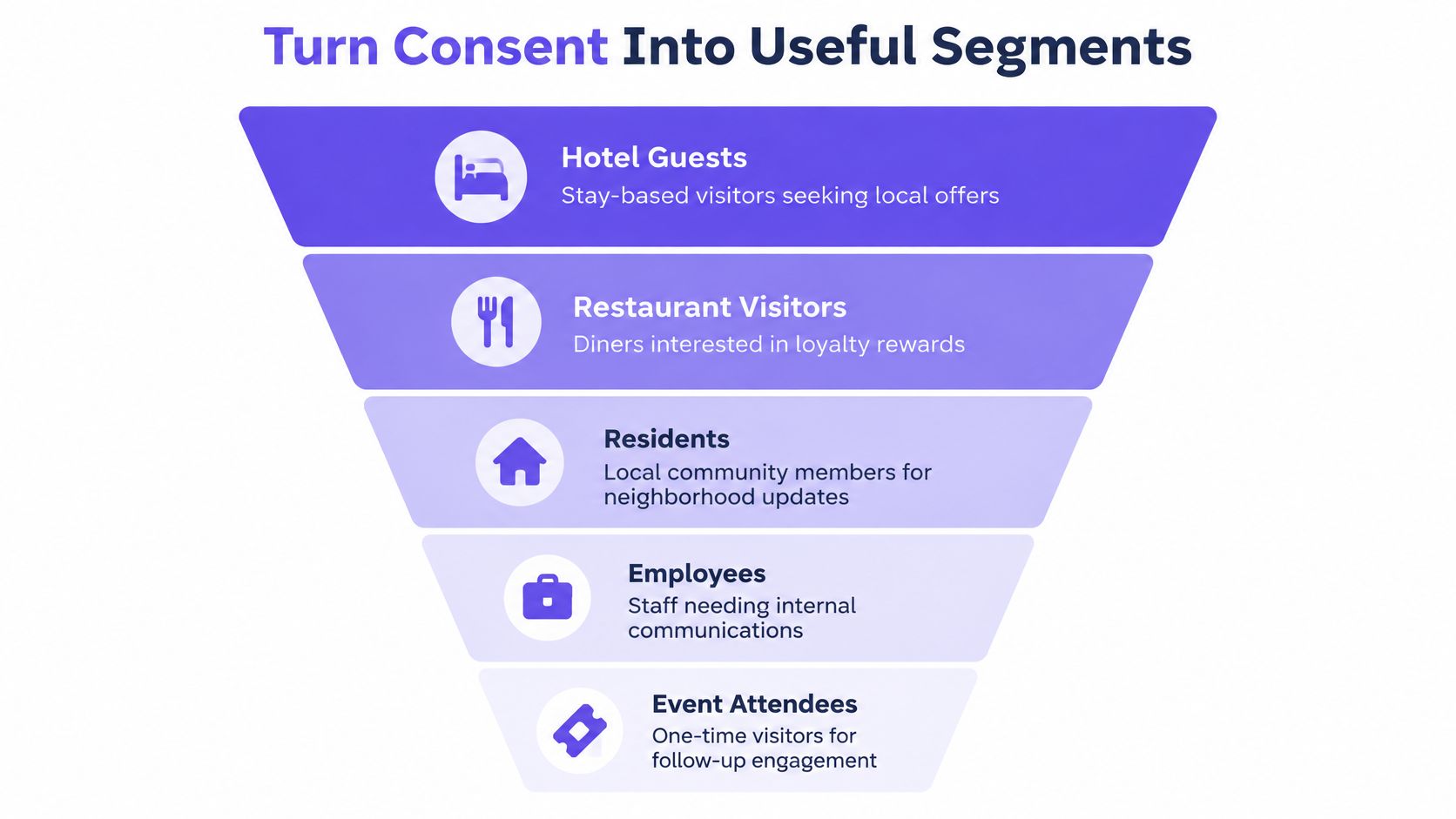
Segment first by visit context, not by every demographic field you wish you had. A hotel guest may value late checkout, local recommendations, or a direct booking incentive for a return stay. A restaurant visitor may respond to a weekday offer tied to the location they visited. An event attendee probably needs timely follow-up about that event, not a generic newsletter months later.
Residents and employees require extra care. They're onsite often, but frequent connections don't automatically make them marketing prospects. Keep operational access decisions separate from marketing profiles, and don't let staff or resident connectivity inflate campaign audiences. If a segment exists for internal communication, govern it as internal communication, not as a promotional list.
Build a fair test
Useful segmentation combines a small number of reliable signals:
- Venue and visit timing: Where the visit happened and whether it was recent.
- Consent state and channel: Whether the person agreed to email, SMS, or neither.
- Visit pattern: First visit, occasional return, or frequent presence.
- Campaign exposure: What they've already seen, so you don't repeat the same offer blindly.
Independent benchmark material in guest WiFi marketing ROI and segmentation guidance reports segmented campaigns can achieve 3 to 5 times higher click through rates and 2 to 3 times higher conversion rates than generic sends. Treat those ranges as a reason to test, not as a result you're owed.
Run a controlled comparison. Send a generic message to one eligible group and a context specific offer to a matched group, using the same eligibility window and frequency rules. Compare incremental conversions per consented contact, revenue per send where you can measure it, unsubscribe rate, and repeat visit rate.
Don't ask whether the segmented email got more clicks. Ask whether it created extra visits or bookings after you account for people who would have returned anyway.
Write the offer from the segment's situation. Mention the venue or event they recognize, keep the call to action singular, and set a clear expiration if the offer has one. Then define suppression rules before you press send. Recent complainers, recent redeemers, employees, and people who opted out shouldn't drift back in because a new list was uploaded. That's how consent becomes relevance instead of volume.
Attribute Results Without Overclaiming
Attribution breaks when every record in the chain gets called a conversion. Keep the stages separate and your reporting gets calmer, more credible, and easier to defend in a budget meeting.
A WiFi connection says a device joined the network. An authentication record says a sign in method succeeded. A marketing profile says you hold contact details with a consent state. Campaign exposure says a message was sent or shown. A click says someone engaged. A redemption or booking says a business outcome happened. Those aren't interchangeable, and your dashboard shouldn't blur them.
Last click attribution is especially risky in physical venues. A guest may see a poster, talk to staff, receive an email, and then redeem at the register. Giving the email full credit overstates what guest WiFi marketing caused. Multi site reporting adds another problem. If locations use different consent wording, eligibility windows, or redemption codes, a global rollup can look precise while hiding inconsistent evidence underneath.
Use a conservative reporting view
Report each campaign with the same fields every time. Show eligible consented contacts, messages delivered, campaign exposure, clicks if relevant, redemptions or reservations, attributed revenue, repeat visits, unsubscribe rate, and an evidence level. Evidence level can be simple language such as directly matched redemption, matched reservation identifier, or modeled estimate. Stakeholders understand uncertainty when you name it early.
Worked scenarios help explain scale without promising outcomes. On 1,000 contacts, moving conversion from 1% to 4% produces 30 additional conversions. At a $40 average spend, that's $1,200 in additional campaign attributed revenue. Label that clearly as a scenario calculation. It shows why conversion quality matters, but it doesn't prove your venue will see the same lift.
Technical hygiene matters here too. If campaign links pass through redirects, broken parameters can erase the evidence you need. Marketing teams should follow a guide for marketing teams on UTM redirects so source, medium, and campaign values survive the journey from message to landing page. Test the full path, including in app browsers and captive portal handoffs, before launch.
Frequency caps belong in the attribution discussion as well. If you message visitors repeatedly without limits, you may harvest a few extra clicks while damaging trust and deliverability. Count unsubscribes and complaints as costs, not footnotes. A campaign that creates modest, well evidenced incremental revenue and leaves the audience willing to hear from you again is stronger than a loud campaign with inflated last click claims.
Protect Trust Privacy and Accessibility
More form fields and higher opt in volume don't prove success. They may prove guests wanted internet access badly enough to push through a process they didn't understand. That's a fragile basis for marketing and a poor basis for trust.
Research on public WiFi users in a CHI study of captive portal usability found captive portals were often confusing and error prone, even though they remain broadly compatible because they don't require a special app. The lesson for operators is direct. If people can't understand the connection process, they can't give meaningful consent within it.
Start by separating network authentication logs from marketing profiles. Logs support security, troubleshooting, and legal obligations. Profiles support consented communication. They may need different access controls, retention periods, and deletion processes. Mixing them invites over retention and makes subject requests harder than they need to be.
Map every data element
Create a plain operational map before launch:
- Email and phone number: Purpose, channel consent, downstream system, and suppression process.
- Device identifier and authentication method: Operational need, retention period, and who can view it.
- Visit history and location context: Why it's kept, how granular it needs to be, and when it's deleted or aggregated.
- Campaign response: Which platform holds it, how attribution uses it, and when raw records expire.
Jurisdiction matters. California privacy guidance in CCPA considerations for WiFi marketing notes consumers have rights to know, delete, correct, and opt out of the sale or sharing of personal information, with disclosure required at collection. Don't present one jurisdiction's rules as universal. Document which rules apply to each property, who is responsible, and how a guest exercises their rights in practice.
Accessibility is part of the same governance work, not a design polish task. Use plain language notices, minimal required fields, optional marketing choices, visible focus states, error messages people can act on, and support for assistive technologies. Analyze abandonment by device type, language, and accessibility need where you can do so lawfully and proportionately. If one group consistently fails to complete the portal, you don't have a marketing insight. You have an access barrier.
Payment areas and staff networks add further separation duties, so align guest access design with wider controls such as those covered in PCI compliance guidance for WiFi networks. The goal is consistent governance. Guests should get clear choices, staff should get clear responsibilities, and auditors should get evidence that matches what the portal said on the day consent was given.
Launch Review and Improve the Campaign
Launch day should feel slightly boring. If you've built in the right order, the portal works, test records landed in the right systems, consent suppressions held, and staff know what a legitimate offer looks like. Excitement at launch usually means somebody is discovering the workflow live.
Use a tight launch checklist. Define the visitor exchange and confirm the wording guests will see. Capture stable connection events with venue, timestamp, method, consent, and exposure fields. Separate required authentication from optional marketing consent. Build contextual segments, test a generic message against a specific one, and connect redemption or booking signals before the first send. Document retention, deletion, and metric owners while the decisions are fresh.
Diagnose the first result honestly
When the first campaign ends, resist judging it by list growth alone. Read the pattern:
- Low portal completion: Look for friction, slow pages, confusing errors, or weak perceived value.
- High opt ins with poor engagement: Check consent clarity, data accuracy, audience fit, and deliverability.
- Strong clicks with weak redemptions: Inspect the offer, landing page, expiration, staff process, and attribution path.
- Low participation in one venue: Consider cell coverage, dwell time, signage, and whether guests need WiFi there.
Each diagnosis points to a different owner. Portal completion may belong to IT and venue operations. Engagement quality belongs to marketing, but only if consent records are sound. Redemptions may fail at the counter because staff weren't briefed, even when the email performed well. Don't let one team absorb blame for a chain it doesn't control.
Set expectations with venue context rather than the most optimistic projection available. A busy hotel, a quick service restaurant, and a small store shouldn't chase identical capture or conversion outcomes. Compare each site with its own baseline first, then look for patterns across similar venues. Improve one variable at a time where you can, such as consent wording, field order, authentication method, segment definition, or offer timing. Record what changed and when, or your next review will turn into opinion.
The core takeaway is simple. Valuable guest WiFi marketing grows permissioned, contextual, and measurable relationships at the point of physical interaction. It doesn't just grow a database. Build trust into the portal, prove results conservatively, and keep improving the parts guests experience. That's what turns connectivity you already provide into a channel your team can rely on.
Purple Access combines identity based WiFi access, branded guest sign in, and consent aware engagement so venue teams can connect access, data capture, and campaign measurement without forcing guests through a confusing portal. If you're rebuilding guest WiFi marketing around trust, accessibility, and evidence you can defend, visit Purple Access to explore how the platform fits your venues.