PCI DSS network segmentation: Scope, testing and pitfalls
Published
In 2024, 90% of organizations scanned by SecurityMetrics' PANscan had unencrypted payment-card data sitting on their devices or systems, a finding that covered more than 112.7 million cards, according to the 2024 PANscan results. Card data turns up in places nobody put it on purpose. Paths into the cardholder data environment behave the same way: they exist in places nobody drew on the diagram.
That's the part most PCI DSS projects get wrong. Teams spend weeks designing VLANs and draw a neat boundary, then discover during the assessment that a development server can still open a session to the payment database. The design was never the hard part. The evidence was.
Segmentation is also the single decision that sets the size of everything else. It determines how many systems an assessor has to look at, how many controls you have to evidence, and how much a flat network costs you every year in scope you didn't need to carry. So it's worth learning properly, starting with what the standard asks for.
Table of Contents
- What Segmentation Does for PCI DSS Scope
- How Segmentation Draws the Cardholder Data Boundary
- Testing and Review Intervals You Must Meet
- How to Test Segmentation Step by Step
- Changes That Force a Retest and Your Pre-Assessment Checklist
- Where Segmentation Fails in Practice
What segmentation does for PCI DSS scope
PCI DSS does not require you to segment anything. It requires you to secure everything connected to the cardholder data environment (CDE), and segmentation is the recognized method for keeping systems out of that definition. Run a flat network and every guest access point, staff laptop, camera and building-management controller stays in scope, with the applicable controls applied to each one. Prove a system can't reach or influence the CDE and it drops out.
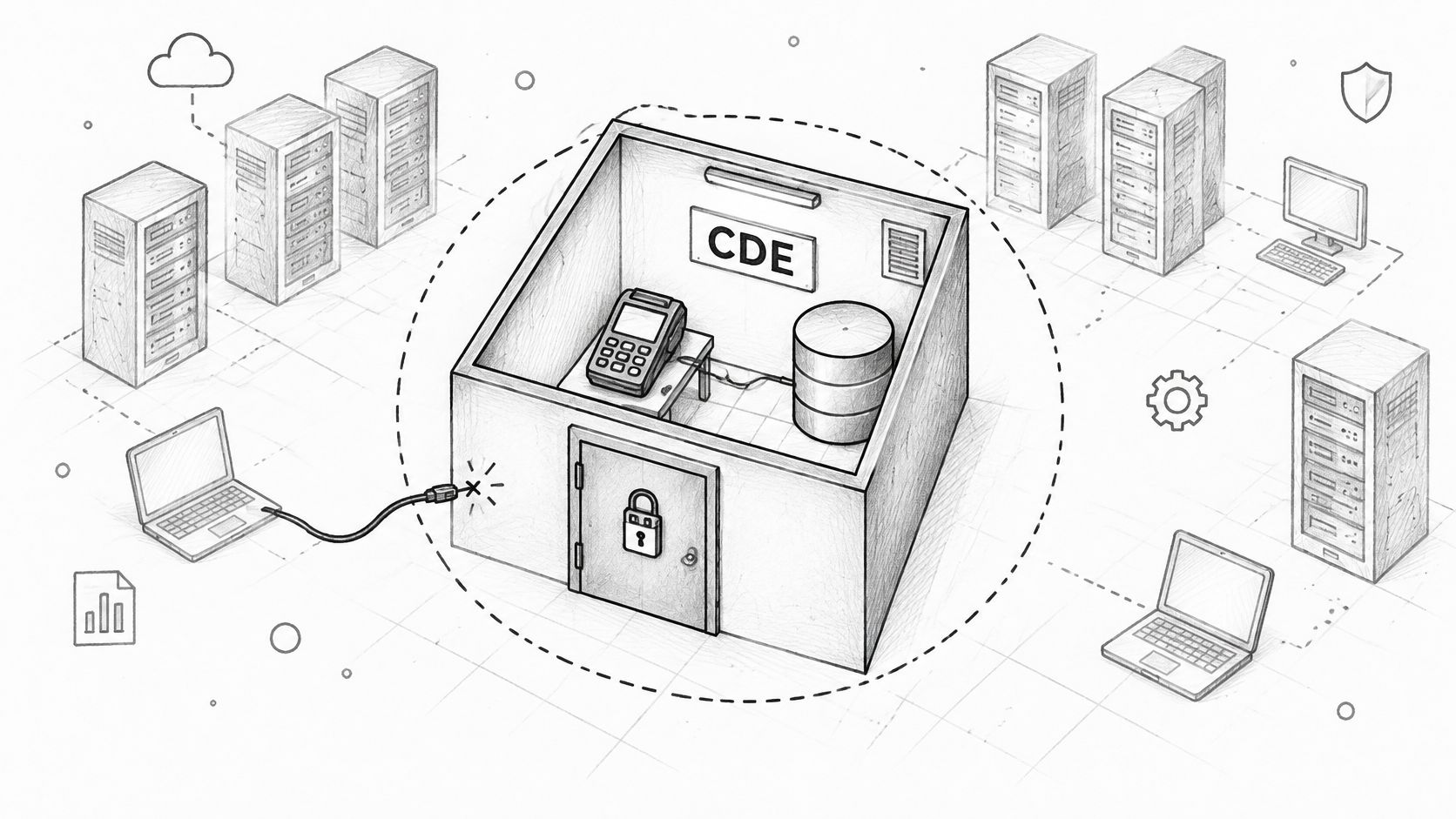
The shape you're aiming for is a small protected core and a wide ring of systems that provably cannot touch it.
Think of a fire door. It only contains a fire when it closes fully, and it only stays reliable when someone inspects it on a schedule. A door drawn closed on a floor plan tells you nothing about the gap under it or the wedge propping it open. Segmentation is the same: the value isn't the wall, it's the tested closure.
A VLAN is a design decision. An out-of-scope system is an evidentiary conclusion, and only a test gets you there.
Where the current requirements come from
The standard has been revised several times. PCI DSS 1.0 launched in December 2004 from five major payment-card brands, 2.0 followed in October 2010, 3.0 in November 2013, and 4.0 in March 2022, as the PCI Security Standards Council's session on risk-directed security records. The 2013 release mattered most for segmentation, because it introduced methodology-based penetration testing to verify that the CDE was isolated from other infrastructure.
What follows is the working sequence: draw the boundary as flows, meet the intervals, run the test, catch the changes that reopen paths, avoid the failures teams repeat, then work the pre-assessment checklist.
How segmentation Draws the cardholder data boundary
The boundary isn't a line on a diagram. It's a rule about connectivity. The PCI Security Standards Council states that systems with connectivity or access to or from the CDE are considered connected to it, so without adequate isolation the broader network falls inside PCI DSS scope, as set out in its guidance on scoping and network segmentation.
The sealed-ward test. A hospital seals an infectious ward by controlling every door into it, not just the main one. One propped fire door and the ward is no longer sealed, no matter what the signage says. Your CDE is that ward. The question an assessor asks is not "is there a firewall?" but "can I get in from anywhere you told me was outside?"
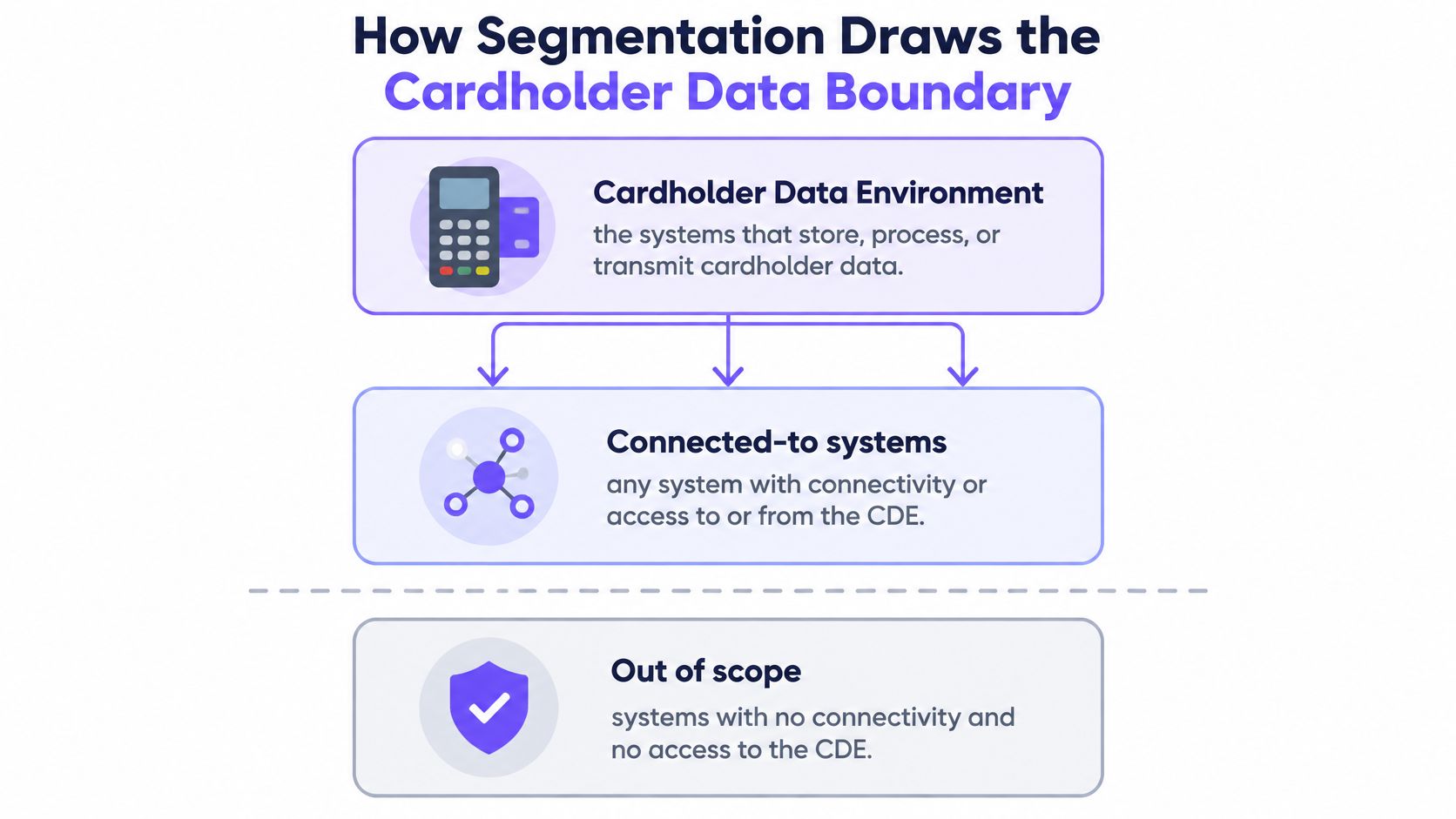
Build a trust-boundary model, not a picture
Effective segmentation means preventing out-of-scope systems from communicating with or affecting the security of CDE components. In practice, that means documenting every permitted path and restricting each to explicitly necessary protocols, ports, and destinations. The list is longer than many expect:
- Firewall rules, including the legacy ones nobody has reviewed since the last migration.
- Routed VLANs and any inter-VLAN routing that touches the CDE.
- Wireless controllers, where an SSID can bridge two segments.
- Management networks and jump hosts, which usually hold privileged access.
- Shared services such as DNS, DHCP, time and logging, reachable from both sides.
- Dual-homed systems, the single most common accidental bridge.
A worked example for a multi-site venue
Take a hotel or a shopping centre with payment terminals at multiple counters. The design goal is to isolate payment terminals and payment-support services from guest, staff, camera, building-management and IoT networks, while allowing only narrowly defined flows such as authenticated management or payment-service communications. Everything else is denied by default, and each allowed flow carries a name, an owner and a reason.
Device-based or directory-based VLAN assignment supports that model, and it's useful when devices move between sites. But the enforcement point, not the identity database alone, has to block unauthorized east-west traffic. A directory that says "this till belongs on the payment VLAN" is a claim. The switch, controller or policy engine that refuses the session is the control.
Where a payment flow leaves your network entirely, the boundary question travels with it. The trade-offs in how Spell supports branded gateways are worth reading if checkout happens on a provider's page rather than your own, because scope then depends on who holds the data and where the redirect lands.
Write the boundary as a list of allowed flows, not as an architecture diagram. Assessors test flows. Nobody has ever failed an assessment because a picture was ugly.
Testing and review intervals you must meet
The standard converts segmentation from an architecture claim into an operating control by setting minimum intervals. Miss them and the scope reduction isn't defensible, however elegant the design, as the breakdown of PCI DSS 4.0 segmentation requirements sets out.
| Who it applies to | Control | Minimum interval | What it must cover |
|---|---|---|---|
| Merchant relying on segmentation | Segmentation penetration test | Every 12 months and after changes | Every segmentation method in use |
| Service provider relying on segmentation | Segmentation penetration test | Every 6 months and after changes | Every segmentation method in use |
| Any organization | Network security control ruleset review | Every 6 months | Each permitted connection across the CDE boundary is justified and limited |
| Any organization | Scope confirmation | At least annually and after significant change | All systems that could affect the CDE |
| Any organization | Segmentation control or method change | Immediately after the change | Targeted reachability test of affected paths |
Merchants must test segmentation controls through penetration testing at least once every 12 months and after changes to the controls or methods. The test has to cover every method in use, which means the firewall rule, the VLAN access-control list and the wireless segment each get proven separately.
Service providers face a stricter floor of at least every six months, plus testing after changes. This is the row teams misapply. If you process or store card data on behalf of other organizations rather than only for your own transactions, you're likely in this row and your calendar is twice as tight as you planned.
Ruleset reviews are separate from penetration testing. Every organization must review network security control rulesets at least every six months, and confirm that each permitted connection across the CDE boundary is justified and limited to necessary traffic. That's a documentation exercise, and it's where stale allow rules get caught.
Practical rule: treat these numbers as a floor, not a target. If your only evidence is one penetration test from eleven months ago, you have a compliance artifact, not a control.
Scope confirmation belongs on the same calendar, at least annually and after significant change, with more frequent validation where it's feasible. If your boundary crosses guest WiFi at any site, the wireless side deserves its own review, and the notes on PCI compliance and WiFi cover the parts that catch people out.
Picking your row starts with one question: for these payment flows, are you the merchant or the service provider? Answer that in writing before you plan the test, because it doubles or halves your workload.
How to test segmentation step by step
Effectiveness has to be demonstrated through penetration testing, not inferred from diagrams or a configuration review. PCI DSS v4.0.1 Requirement 11.4.5 requires testing segmentation controls at least once every 12 months and after changes to segmentation controls or methods, with coverage of every method in use and confirmation that controls are operational, effective, and isolate the CDE from out-of-scope systems, per the PCI DSS v4.0.1 standard.
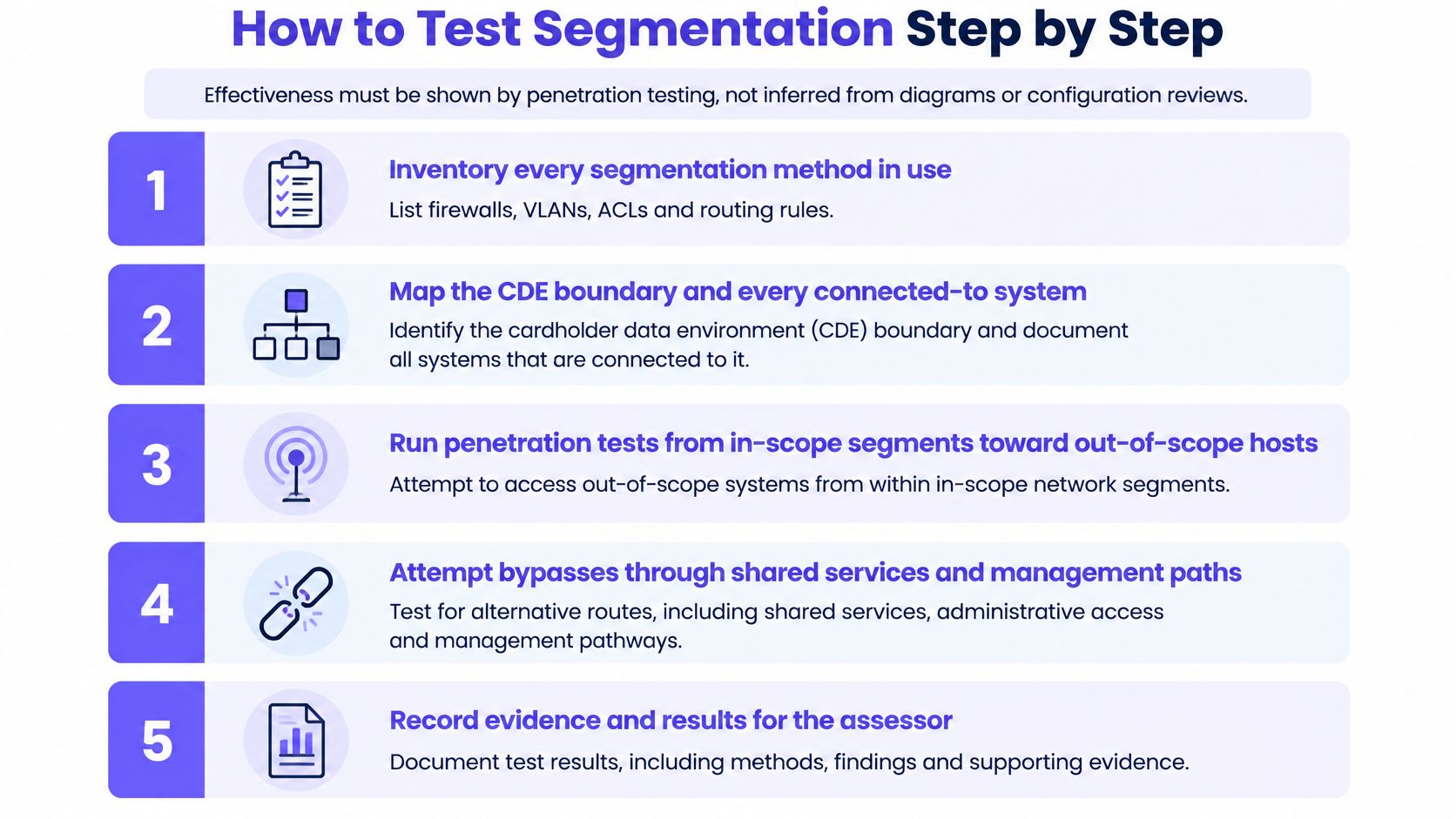
The procedure below is the one that survives scrutiny. Each step exists because skipping it is how a passing test becomes a failed assessment.
The test procedure
- Inventory every segmentation method in use. Firewalls, VLAN access-control lists, routing restrictions, wireless segmentation and identity policy all count. The test must cover all methods, so an incomplete inventory produces an incomplete test that an assessor can disqualify.
- List every materially different zone to test from. Guest WiFi, corporate endpoints, development networks, facilities and IoT segments, and management paths. Each zone has different routing and different policy inheritance, so each one is a separate test case rather than a representative sample.
- Probe actively from each zone toward the CDE. Use host discovery and port scanning instead of reading configurations. Configuration tells you what should happen; probing tells you what does.
- Test each control type separately. A firewall policy, a VLAN access-control list, a routing restriction and a wireless segment are four different controls and need four verdicts. Bundling them hides the one that's broken.
- Record every permitted and denied flow. Note the intermediary devices in the path, and any administrative interface you can reach. A reachable management page is a finding even if the data port is closed.
- Classify each finding as isolated, reachable or influencing. Isolated means no route. Reachable means a session got through. Influencing means the system can't connect but can affect CDE security, through shared DNS, logging, management or a trust relationship, and it stays in scope.
- Remediate the path, then retest the same route. Same source, same destination, same protocol. A retest from a different workstation proves nothing about the path you fixed.
- Store dated results, test scope and configuration snapshots in one place. The assessor needs to see what was tested, when, from where, and what changed afterwards.
Who runs the test, and what happens when a path is found
Use a qualified internal resource with organizational independence from the controls being tested, or an external tester. The report should name each zone tested rather than describing a general attempt, because a summary that says "external testing performed" gives an assessor nothing to verify.
The PCI SSC's testing guidance recommends actively seeking routes from outside the CDE using host discovery and port scanning, and testing each control type. If your segmentation leans on VLANs, the mechanics in VLAN segmentation shape how the tester scopes source zones and trunks.
When a route is found, the honest move is to widen scope, not narrow it. A single unintended route invalidates the assumed scope reduction, and testing should be repeated after firewall, switch, WLAN, RADIUS, VLAN, cloud-connectivity or identity-policy changes. Treat the reachable network as in scope until the path is closed and retested. That costs you one assessment cycle and buys you a boundary that holds.
Changes that Force a retest and your pre-assessment checklist
Most public explanations reduce the testing obligation to an annual penetration test. PCI DSS v4.0.1 also ties testing to changes in segmentation controls or methods, and requires the test to cover every method in use, as the 2024 PCI DSS v4.0.1 text makes clear. That second clause is the one that catches mature programs.
The difficulty is that segmentation changes rarely arrive labelled as network redesigns. Someone adds an SSID, edits a RADIUS attribute, onboards an access point, tweaks a firewall object, introduces a cloud connector, rotates certificates, or lets a facilities vendor manage payment-adjacent equipment. Each of those can open a path without anyone opening a change record titled "segmentation".
| Change | Path it can open | Targeted test |
|---|---|---|
| Adding or renaming an SSID | New wireless path that may bypass existing access-control lists | Wireless reachability from guest and staff zones |
| Changing RADIUS attributes or VLAN mapping | A device lands on a different segment than intended | Authorization test per device group, before and after |
| Onboarding a new access point or switch | New shared switching path | Layer 2 isolation and VLAN trunk review |
| Editing a firewall object or rule | A permissive rule opens a route | Full reachability test of affected CDE paths |
| Adding a cloud connector or SaaS integration | New external route into the network | Route and egress review from every zone |
| Rotating certificates or changing identity policy | Devices that should be refused are accepted | Negative test with a revoked or non-compliant device |
| Granting vendor remote access to facilities or payment equipment | Administrative path to CDE devices | Reachability test of admin interfaces from the vendor segment |
The changes that don't look like changes
Wireless key rotation is the clearest example. PCI DSS v4.0.1 Requirement 2.3.2 requires wireless keys to change when anyone who knows them leaves, which a shared key makes impractical. So a staff departure becomes a segmentation event: new credentials, new join records, and a fresh question about which VLAN each device lands on. If your only trigger is a calendar date, that question goes unasked until the next assessment.
The same applies to certificate rotation under a device-management rollout, or a vendor support tunnel opened for two days and never formally closed. None of these show up as an architecture change. All of them can move a device across a boundary.
A change-triggered assurance playbook
Define in advance which events require a targeted reachability test, rather than debating it in the middle of a maintenance window. Test from every relevant zone, not just the one you changed. Keep before-and-after authorization evidence for each change so the assessor can see what the policy did prior to the edit and after it.
Before you book the assessor: reconcile your network diagrams against live firewall policy and authentication data. If they disagree, that mismatch is a finding in its own right, and it's much cheaper to record it yourself than to have it found for you.
Pre-assessment checklist to run this month
- Confirm your classification. Merchant or service provider, written down, with the matching testing interval noted next to it.
- Rewrite the CDE boundary as a list of permitted flows, including shared services and every vendor path, with an owner for each.
- Check test coverage. Has a segmentation test run from every zone, within the interval, and after your most recent change?
- Map last year's changes to retests. Every entry on the table above should point at a test, or at a documented decision that no path changed.
- Consolidate evidence. Test reports, ruleset reviews and authorization logs in one place, dated, so the assessor can follow the chain from claim to proof.
Where segmentation Fails in practice
The question that comes up most is whether a VLAN-based design makes systems out of scope by itself. It doesn't. PCI DSS doesn't mandate segmentation, but an organization relying on it must demonstrate that out-of-scope systems cannot affect the CDE, and an assessor evaluates whether the isolation works rather than whether VLANs, access-control lists or firewall rules are documented, as the compliance analysis published by Reuters Practical Law explains.
That distinction can cost teams weeks. Documentation describes intent. Testing proves reachability. A nominally separate VLAN with an unintended route, a management path or a permissive identity policy can still expose the CDE.
| Challenge | How it breaks segmentation | Fix |
|---|---|---|
| VLAN-only design | Configuration exists, but no test proves the path is closed | Penetration test every segmentation method in use and keep the evidence |
| Shared services | DNS, DHCP, time or logging servers are reachable from both sides | Treat shared services as part of the boundary and restrict their flows |
| Dual-homed devices | A server connected to guest and payment networks forwards traffic between them | Remove dual-homing or isolate the device and document the exception |
| Temporary devices | Contractor laptops or pop-up tills join a permissive segment | Isolate by identity, limit access by time, and revoke on exit |
| Out-of-date diagrams | Documented scope differs from live firewall and authentication policy | Reconcile diagrams with live policy and authentication data each change cycle |
| Vendor access | Remote support tunnels cross into CDE-adjacent systems | Restrict vendor paths to named devices and log every session |
Multi-site venues carry all six at once. Guest, staff, IoT, payment and building-management networks coexist on shared switching, shared wireless and shared internet egress, and every one of those shared paths is a candidate bridge. A pop-up till at a seasonal event is a temporary device that joins a guest segment, gets used for a week, and stays in the authentication database for a year.
Technology supports compliance but doesn't establish it on its own. Identity-based assignment, prompt revocation and authentication logs are strong assessor evidence, because they show who joined which segment and when access was withdrawn. Present them as evidence, not as proof of isolation, and you'll have a much easier conversation.
The practical target is a continuously auditable isolation model: a boundary you can re-prove after any change, from any zone, with records that trace each claim to a result. If guest and staff networks sit inside your CDE scope today, the material on guest network security covers how to separate them without breaking the guest experience.
Purple Access runs three networks, open, secure and xPSK, with Cloud RADIUS placing every device on the right one by identity so guests, staff, tills and card terminals land on separate VLANs with their own policies. Each till or terminal can hold its own key with its own VLAN and bandwidth limit, and revoking one device doesn't touch the rest, which gives you the authentication record an assessor asks for. If you'd like to see how your current SSIDs map onto that model, book a 45-minute design session with a Purple network engineer, who'll plan it against the access points you already own and leave you the plan, at Purple Access.